
 I’ve been blogging regularly since May 2011, which makes DonorDreams blog three years old next month. As with everything in life, there have been ups and there have been downs with things such as readership, content, and tech issues. I’m sure those of you who know me well, won’t be surprised to read that I tend to obsess over questions such as:
- Is the post is too long or too short? Will people read it?
- Is the headline going to capture readers’ attention and result in a click-through?
- Is the email subject line going to result in a higher open rate?
- Is the tweet too long or too short? Will it result in a RT?
- Are my sentences too long? What about my paragraphs?
I know some of you are rolling your eyes and chalking these questions up to my obsessive personality. While this reaction is well deserved, the reality is that there is a science to how you compose your non-profit organization’s emails, tweets, blog posts, etc. And since you’re not emailing, tweeting and blogging just for the heck of it, I think it is important to understand the science behind these things, especially if you want people to read your stuff.
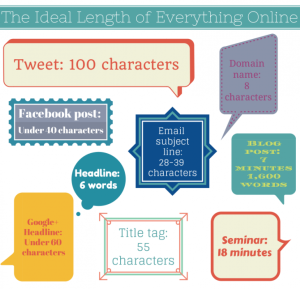 Last week, an old friend of mine from high school poked me on Facebook and posted an article from Kevan Lee at the Buffer blog. He does an awesome job of untangling the facts and figures while sharing some really great charts and graphs on this subject.
If you want your donors to read your Facebook posts, tweets, website and blog content, then this link is worth the click. Kevan even developed a wonderful little infographic to help you remember and use the content in his post. I’ve included it in this post for your review.
When it comes to evaluation strategies for DonorDreams blog, I have not been very fancy because I don’t have any money budgeted for those types of activities. The blog is just a labor of love. So, when I’ve wanted to know something (e.g. whether or not the theme formatting of the blog is attractive, etc), I’ve simply asked readers and friends for feedback. How did I do this? I went on Facebook and Twitter and asked.
Does your agency evaluate and play with content, length of content, and promotion strategies? If so, what have you found? What measurement strategies did you use? What did you do with what you learned? Please share your thoughts and experiences in the comment box below. We can all learn from each other!
Here’s to your health!
Erik Anderson
Founder & President, The Healthy Non-Profit LLC
www.thehealthynonprofit.com
erik@thehealthynonprofit.com
http://twitter.com/#!/eanderson847
http://www.facebook.com/eanderson847
http://www.linkedin.com/in/erikanderson847

 One great suggestion I found in this resource was to think about ways to turn your charity projects into brands (e.g. the Tap Project). It helps if the brand is descriptive, as opposed to abstract, because people tend to search for generic terms. For example, “CureBlindnessNow” could be both a brand and a search term i.e. “cure for blindness”, “how to cure blindness”, etc.
 In a recent conversation with a friend about their non-profit board, it came to light that board members used email to take an important vote because scheduling a special board meeting was too difficult with everyone’s busy schedules.
 The following are just a few suggestions you may want to consider:
 OK, Erik is back from baseball Spring Training, today is Opening Day and DonorDreams blog is back. Since it is Monday, we’re looking at Chapter 17 of Lon Safko’s “
 At my previous agency, their national office made tremendous investments in webinars (aka distance learning). The following are just a few of the training titles I saw them offering:
 Many people have discovered Slacker radio, but online radio isn’t just about streaming music while you workout.
 How does Twestival work?
 A few short years ago, we couldn’t have even imagined such a scenario. In the past, proximity and commonality brought us together. We had family and close friends; help came from familiar places.
 And I already see that I’m not adapting fast enough to keep pace with the innovations. The technology school bus isn’t waiting for me!