
 Every year, it seems like one of the charities I support is celebrating some kind of anniversary or milestone. Most of the time, it relates to the age of the organization, and it is typically a milestone like 25, 50, 75 or 100 years of existence. Sometimes it is a different kind of anniversary, where they’re celebrating a board member’s years of service or the age of something physical like a building. Regardless of the opportunity to celebrate, a fundraising solicitation is never far behind; however, anniversary celebrations can be so much more than just putting your hand out.
I graduated from the University of Illinois Urbana-Champaign (UIUC) with both a BAUP (1992) and MUP (1994).
I know most of you are thinking “HUH?”
BAUP is a Bachelor of Arts in Urban Planning, and a MUP is a Master’s degree in Urban Planning.
I spent six amazing years learning about the ins and outs of planning from some of the most amazing professors. In hindsight, I was laying a foundation of knowledge and practices that would serve me well as a non-profit consultant almost 20 years later. I have literally lost count of how many plans I’ve facilitated and written since graduating (e.g. strategic plans, tactical plans, succession plans, resource development plans, board development plans, marketing plans, business plans, etc).
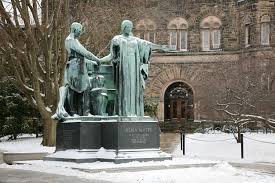 A few weeks ago, I started getting email and snail-mail announcing the 100th anniversary of the Department of Urban and Regional Planning (DURP) at the University of Illinois.
Wow! 100 years . . . how could that be possible?
After some head scratching, I vaguely recalled the University of Illinois was only the second school in the country to offer urban planning curriculum back in the early days when planning was just getting off the ground as a profession.
Normally, I am not influenced by most non-profit organizations’ anniversary efforts to get money out of me as a donor. However, I am amazed at how many times I’ve found myself thinking about writing a small check to my Alma Mater in honor of the department and the people who gave me so much.
After the second or third time of almost making a contribution, I started wondering what DURP and UIUC are doing differently from so many of the other non-profit organizations in my life. So, I went back to the communications materials and mail solicitations and looked for clues. Here is what I found:
- Their fundraising effort isn’t front and center. They don’t beat you over the head with their hand out. It is subtle.
- Their focus is on sharing nostalgia and memories, and they want this to be a two-way experience.
- They’re using this as a donor engagement activity by asking alumni to help them in a variety of ways.
 For example . . .
- I’ve been asked if I have any interest in becoming a mentor to a student.
- They’re conducting a remembrance activity and asking alumni to submit stories about their time on campus with the department.
- They’re looking for old pictures for their archive.
- Of course, there are two days worth of celebrations and activities on campus in early November where you can walk down memory lane and reconnect with faculty and friends.
- Oh yeah, just as a side note, they’re announcing the start of a new scholarship fund for planning students. 😉
Over the years, I’ve read tons of fundraising articles, papers and books. In addition to considering myself a “planner” by education and trade, I also proudly consider myself a “non-profit and fundraising professional“. While my recall isn’t working well this morning, I have some vague recollection of someone once saying that “good fundraising” is 95 percent about listening and engaging versus 5 percent solicitation.
Will I write a small check? Will I attend the anniversary festivities? Will I take the time to submit a remembrance story?
I dunno. Maybe.
What I do know is that your non-profit organization can learn a lot from my Alma Mater with regards to using an anniversary celebration to deepen the level of engagement with your donors and raise a few bucks along the way.
The following links are additional resources I dug up for your review on this subject:
- IMPACTMAX: “It’s your nonprofit’s anniversary? Who cares . . .“
- Amazon.com: “Celebrating Your Nonprofit’s Milestones: 81 Great Ideas for Planning & Celebrating Milestone Events“
- The Chronicle of Philanthropy: “Planning a Successful Anniversary Celebration“
Is your agency planning a big anniversary celebration? If so, please share your plans. Have you ever been a part of another institution’s milestone celebration? What did you like? What didn’t you like? How did they weave resource development opportunities into the mix? Please share your thoughts using the comment box below.
Here’s to your health!
Erik Anderson
Founder & President, The Healthy Non-Profit LLC
www.thehealthynonprofit.com
erik@thehealthynonprofit.com
http://twitter.com/#!/eanderson847
http://www.facebook.com/eanderson847
http://www.linkedin.com/in/erikanderson847
 I was reviewing some old non-profit board governance material this morning and came across a document talking about “trends in non-profit governance“. In other words, the person who wrote that paper thought s/he was able to predict the future. Of course, this document was written more than 10 years ago, which got me thinking it might be fun to review some of their trends and determine where they were right or wrong.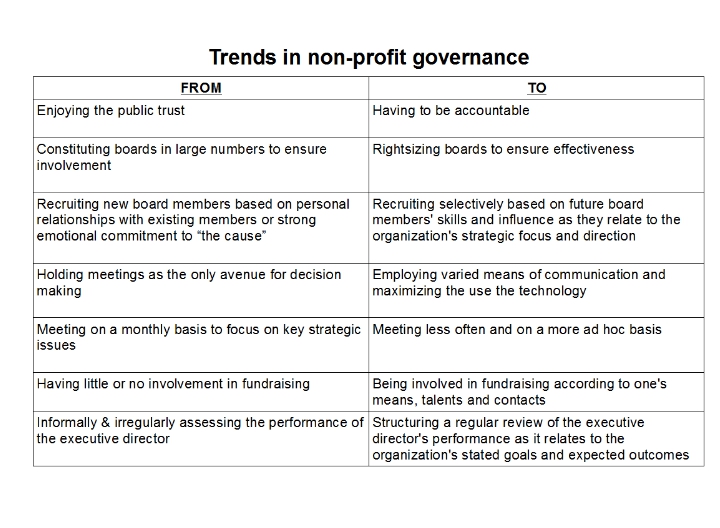
 A few months ago, I had a horrible experience with my favorite airline. Long story short . . . delay, delay, delay, delay, loaded on the plane, equipment malfunction, delay, delay and finally up-up-and-away. A whole day was lost. However, in that catastrophe, I was able to learn something about Twitter and the new age of customer service. In the last few weeks, I’ve been reminded of this experience when two bloggers talked about Twitter. So, I thought I’d we’d look Twitter a little more closely today, especially as it relates to non-profit organizations.
 I am on Twitter every day. I’m not there very long. I’m not a Twitter expert. I’m sure that I am doing lots and lots wrong in the eyes of social media experts. However, I do see lots of content and most of those who I’m following are non-profit organizations.
 This is a tough question to answer because I suspect it may vary slightly from agency-to-agency. However, some of the better non-profit organizations are tweeting the following:
 Sometimes I see things at just the right time and in the right place, and it results in me seeing something differently. Usually, when this happens it results in an AH-HA moment. This is exactly what happened to me yesterday when I opened an email from my friends at
  So, the title of today’s blog post had the word “AH-HA” in it, which implies that my friends at Non-Profit Humour inspired a light bulb of some sort.
 Yes, yes, yes . . . I know what you’re thinking: “Our agency doesn’t have things like hotel rooms, flights and cups of coffee to give away like these for-profit corporations.” But are you sure about that? Because I’ve attended many charity auctions in my life.
 Last week I was out with a friend for a glass of wine after work. We hadn’t seen each other in a few months, and we were catching up on lost time. “How are you? How is the new job? How’s your wife? Kids? Grandkids?” You know the drill. It was during this exchange that he dropped the bomb: “So, how is your partner? Ya know … the only time I ever see him is when he is asking me for a donation.”
 These personal touches do not have to be all about your non-profit organization. I suggest that you train your volunteers to be less obvious. For example, both stewardship touches could be as simple as three minutes worth of messaging in the middle of a lunch meeting or after-work cocktail. It should feel organic and nature. It shouldn’t feel forced or contrived.
 Welcome to O.D. Fridays at DonorDreams blog. Every Friday for the foreseeable future we will be looking at posts from John Greco’s blog called “
 If I’ve seen it once, I’ve seen it hundreds of times. And I bet you have, too. I will omit the names to protect the innocent.
 We’ve also all seen this situation.
 A non-profit organization that doesn’t invest time and resources into evaluation and critique is akin to an ostrich sticking its head in the sand.
 Welcome to part four of our five part series on Governance. We have already discussed the Board’s role in
 Welcome to O.D. Fridays at DonorDreams blog. Every Friday for the foreseeable future we will be looking at posts from John Greco’s blog called “
 I find this distinction really fascinating, and I haven’t been able to stop thinking about it since I read this post. So, I’ve been focused on identifying some non-profit related “predicaments” and here is what I’ve come up with . . .
 Recently, I’ve been doing a lot of what I consider “Nonprofit 101” trainings focused on board roles and responsibilities. After talking with board members about their fiduciary responsibilities, they often push back on their role in fundraising. I’m becoming really good at giving them the “sympathetic smile,” which communicates that I’m hearing their fear but not giving them permission to wash their hands of their role in resource development.
 After all, how scary can it be to “tell stories,” right?
 Welcome to O.D. Fridays at DonorDreams blog. Every Friday for the foreseeable future we will be looking at posts from John Greco’s blog called “
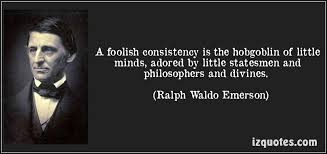
 Well, huh? Let me see here. Every good planning process begins with an assessment /evaluation which springboards off into goal setting, strategy development and action planning. If the organization I just referenced hadn’t been so “foolishly consistent,” they would’ve seen the following:
 The board members and executive director of the agency I reference in the example above certainly were “little“. I say this because their “foolish consistency” and unwillingness to do any assessment and planning had locked them into being a certain size. When you looked at their agency budget, they had brought in the same amount of revenue for the last 10 years.