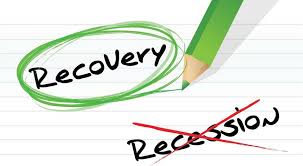
 That is it . . . I am fed up and can’t stop myself from saying something that has been on my mind for a little while now. Can non-profit organizations please stop running around and telling anyone who will listen that the economy is bad and the recession is hurting their agency?
I hear my non-profit friends (both staff and board volunteers) bemoaning how bad it is and how they’ve been impacted. I know that I’ve heard it at least once a month going back to the 2008 stock market meltdown, which by the way was FIVE YEARS ago.
I totally understand why people were talking about this 12 to 24 months removed from the epicenter, but as I just pointed out more than half-of-a-decade has passed since that time.
The fact of the matter is the recession officially ended in June 2009, according to Cycle Dating Committee of the National Bureau of Economic Research. Don’t believe me? Just go ask Google.
In fact, the Blackbaud Index just arrived in my email inbox, and they are estimating that charitable giving rose 4.9% in 2013. Additionally, online giving increased by approximately by 13.5%.
When I see numbers like these, it always stirs my emotions when juxtaposed against comments such as:
- “The economy is bad and donors just aren’t giving.“
- “We can’t ask people for money while the economy is still doing so poorly.“
- “Our agency hasn’t recovered from the economic downturn.“
- “Our board members are afraid to ask their friends for charitable contributions as long as the economy is doing so poorly.“
Believe it or not, I heard some variation of each of these comments just this last weekend!
At first, I found myself shaking my head and asking the obvious question, “WHY?” However, I quickly stopped that when I realized that I know the reasons why. Here is what I think drives those comments:
- Fear is irrational and people believe what they believe in spite of facts.
- Some parts of the country are taking more time to emerge from recession.
- Some non-profit agencies never adjusted their revenue model and resource development plan to accommodate for what economists are calling “The New Normal“.
- Some non-profit professionals are always looking for excuses to justify poor fundraising performance.
- Some misguided fundraising professionals and volunteers think pleading poverty and pointing at the economy makes for a good “case for support” (which really works the opposite way on how donors perceive your case).
Regardless of whether or not you believe these reasons, the reality is that we need to shake ourselves out of this mindset. Our clients deserve better and whining has never been shown to solve problems.
So, what should you do to combat this mindset? I suggest the following:
- Involve your volunteers in developing a new resource development plan and answering this simple question: “If how we raised money before the recession doesn’t work anymore, then what should we do to secure the resources we need to fund our mission today?“
- Involve your volunteers in developing a new case for support document and build consensus to stop talking to donors about the economy.
- Be the change you want to see in the world and stop talking about the economy.
- Take your volunteers by the hand and go with them on cultivation and stewardship visits with prospects and donors.
- Engage in benchmarking activities and compare your agency’s fundraising performance to other non-profit organizations (e.g. check out Blackbaud’s performance comparison tool by clicking here).
What are you doing to combat this insidious, self-defeating mindset that is still pervasive in many non-profit boardrooms? Please use the comment box below to share your thoughts and experiences. We can learn from each other.
On a side note, before you take me to task with comments about my insensitivity, please know that I know there are people out there who are still hurting. I have never said there weren’t. In fact, I know some of those people, and I am sure you do, too. However, the reality is that non-profits cannot wait until there is no more unemployment. Our agencies cannot wait until economic indicators are back to the ridiculous 1990s levels. Those who wait for that to occur won’t be in business for much longer. Let’s rediscover that often-celebrated “American spirit” of picking ourselves off the ground and doing the hard work to get our agencies moving again.
There! I’ve said it . . . now please feel free to excoriate me. 🙂
Here’s to your health!
Erik Anderson
Founder & President, The Healthy Non-Profit LLC
www.thehealthynonprofit.com
erik@thehealthynonprofit.com
http://twitter.com/#!/eanderson847
http://www.facebook.com/eanderson847
http://www.linkedin.com/in/erikanderson847
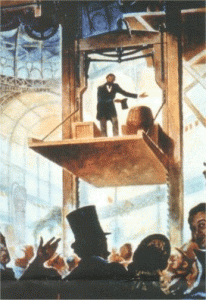 Thousands of spectators flooded into the Crystal Palace Exposition in New York City.
 But I under appreciate the downside risks. I, consequently, short change the risk mitigation section of the proposal. In fact, sometimes I omit it entirely.
 My online friend, Marc Pitman is hosting this month’s Nonprofit Blog Carnival and asks his fellow non-profit bloggers to write an open letter to executive directors in honor of President’s Day. For those of you who don’t know of Marc, he is well-known to friends and business associates as “The Fundraising Coach“. As the coach describes in his
  In this post I will be sharing one of the most profound and impactful lessons of my life.
 That’s quite a stretch you say? Okay, another possibility: because you are not so much concerned about the project now, you can devote some time and energy to researching twice a week home nursing visits for your mom. That concern just slid into your circle of influence…
 In my humble opinion, non-profit professionals have two choices:
 Over the last few months, I’ve found myself doing a lot of boardroom trainings on the subject of “Board Roles & Responsibilities“. When facilitating this training, there are two different slides talking about the board’s collective responsibilities and the other illustrates individual board members’ responsibilities. Listed on both slides at the top of the list is the responsibility of “asking questions“.
 Of course, we aren’t talking about asking questions that lend themselves to micro-management of staff. Here are just a few important questions that good boards ask:
 I tried to picture what a non-profit board might look like if it didn’t ask questions, and these words all came to mind:
 “Grab a piece of paper. Make your best paper airplane.”
 Often in these sessions, after one or two unsuccessful flights I see the “pilot” start adjusting the paper plane: a different fold there, a bending of the wings, sharper folds at the point… When I see this, I react —“Whoa!” What are you doing?”
 Working with organizations in New Mexico and West Texas means lots of windshield time, and last week I found myself contemplating the question: “What is the biggest cardinal sin a non-profit executive director can commit?” In the final analysis, my conclusion surprised me, which means it was destined to end up here on the DonorDreams blog for you to chew on and contemplate.
 A CEO who had begun to practice his own form of “management-by-walking-around” learned from his employees that the company inhibited innovation by subjecting every new idea to more than 275 separate checks and sign-offs. He promptly appointed a task force to look at this situation, and it eliminated 200 of the obstacles. The result was a higher innovation rate.
 Phenomenal!: “What assumptions am I making and what biases do I hold that are manifesting themselves in the culture of this organization, leading to an approval process with 275 signoffs and associates that are reticent to challenge that process?
 I cannot tell you the number of people over the course of my 20 years in non-profits that either congratulated me for running my non-profit like a business and went on to tell me non-profits should be run like a business. I never knew what to say. Thank you?
 Non-profits have to manage the budget AND meet the mission.
 Non-profits are not run by one person for a reason. The Board represents the community as the owners of the organization. The organization exists to meet a need. Businesses, which also address needs, exist to make money.