
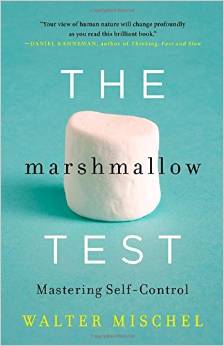
 I’ve been on the road a lot lately. When this occurs, I typically look for eBooks to help pass the time during airport delays and other frustrating travel hiccups. Last week, I downloaded The Marshmallow Test: Mastering Self-Control. I selected this work of non-fiction because I blogged about it on October 26, 2012 in a post titled “Does your non-profit agency pass ‘The Marshmallow Test’?” It was part of an ongoing series we called “Organizational Development Fridays” at DonorDreams blog, and it was based on OD blog posts at “johnponders ~ about life at work, mostly”.
The Marshmallow Test blog post was one of my favorite posts during that time period. So, when I saw the eBook I knew that I just had to read it.
I suspect the next few DonorDreams posts this month will likely connect back to this book. Today, we are talking about the always elusive idea of what characteristics and traits make-up a productive non-profit board volunteer.
The Marshmallow Test explained
The Marshmallow Test (as it has been dubbed by the media) is an experiment to test self-control in small children. In a nutshell, here is how it works according to Walter Mischel, the book’s author and lead researcher:
“On the table were a desk bell and a plastic tray the size of a dinner plate, with two cookies in one corner of the tray and one in the other corner. Both the immediate and the delayed rewards were left with left with the children, to increase their trust that the treats would materialize if their waited for them as well as to intensify their conflict.”
Here were the rules:
- The researcher would explain to the child that they had to leave the room for a little while. The child would be left alone with the rewards in plain sight.
- The child could ring the bell at any time and the researcher would come back immediately.
- If the child waited until the researcher came back without ringing the bell, then the child would earn the two cookies (aka marshmallows) on the plate in front of them.
- If the child rang the bell and summoned the researcher back, then they would only earn one cookie.
- The child had to remain in their seat and not wander off to play in other part of the room.
- The child was allowed to eat one cookie at any time, but if they did then they forfeited their right to the second cookie.
Researchers observed behavior and timed how long various children took before they rang the bell or caved in and ate a treat.
In subsequent years, researchers have followed up on their research and found that kids who did better on the tests (exercising self-control and opting for the delayed reward) actually did better in life (e.g. income, retirement savings, weight control and health, etc)
Using marshmallows during board recruitment?
Of course, this is a whimsical question. I’m not suggesting you pull out marshmallows and administer the test as part of your agency’s board recruitment process, but the mental image makes me giggle.
However, as I read more and more of the book, I find myself wondering if some of the characteristics and traits of those who practice self-control should be added to our board development prospecting processes.
For example, the following is a list of key board member competencies and characteristics that I recently found included in a sample non-profit board member job description:
- Has achieved recognition and status within the community.
- Is knowledgeable about the social concerns of the community.
- Has the resources (personal and/or corporate) to apply to the needs of the organization.
- Is committed to youth and the agency’s mission.
- Has the ability to listen, analyze, and think strategically.
- Has the ability to work well with others and demonstrates tolerance of differing points of view.
- Is willing to prepare for and regularly attend board meetings and relevant committee meetings.
- Exhibits honesty and sensitivity.
In Chapter 8 “The Engine of Success: I Think I Can!” the author ends the chapter with the following list of characteristics and traits of successful people who exercise self-control and maintain an optimistic view of life:
- pursue goals with persistence
- develop optimistic expectations for success
- cope with frustrations, failures and temptations
- inhibit impulsive responses
- develop mutually supportive, caring friendships
I couldn’t help but wonder if these characteristics and traits should be added to our prospecting criteria when searching for new non-profit board volunteers?
What criteria does your agency use as part of its board development cycle? How do you assess whether or not a prospect possesses those traits and characteristics? How many of your board volunteers would pass “The Marshmallow Test” if it were administered at the start of your next board meeting? What does that say about your board? 😉
Please use the comment box below to share your thoughts and experiences. We can all learn from each other.
Here’s to your health!
Erik Anderson
Founder & President, The Healthy Non-Profit LLC
www.thehealthynonprofit.com
erik@thehealthynonprofit.com
http://twitter.com/#!/eanderson847
http://www.facebook.com/eanderson847
http://www.linkedin.com/in/erikanderson847
 An African farmer heard tales about people who had made millions by discovering diamond mines. These tales so excited the farmer that he could hardly wait to go prospecting for diamonds himself. He sold the farm and spent the rest of his life wandering the African continent searching unsuccessfully for the gleaming gems that brought such high prices on the markets of the world. Finally, worn out and in a fit of despondency, he threw himself into a river and drowned.
 Jerry, the financial analyst, can make a mean bouillabaisse. Mary, the executive admin, is a Toastmasters organizer. Julie, in inside sales, does graphic design for her church’s marketing pieces. Peggy, in tech support, is a stand up comedian. Bill, in logistics, does resumes on the side for family and friends. Susan, in customer support, is on the board of a local non-profit. Judy, a software tester, volunteers at the local hospice. Christian, a call center agent, paints. John, an industrial engineering manager, blogs. Damian, a research analyst, is an actor in a local drama troupe.
 If you Google the definition of “Pandora’s Box,” the all-knowing internet oracle says the term means: “a process that generates many complicated problems as the result of unwise interference in something.” I love this expression, and I used it a few months ago when talking to the board president of a non-profit organization who was describing to me how they were handling a complaint about the agency’s executive director.
 I woke up this morning with the words of Samuel Jackson echoing through my head. While this actor has played a number of different roles in Hollywood, the words in my head were from his Capital One credit card commercials . . . “What’s in your wallet?” As I shuffled around my hotel room trying to wake up, I started reviewing all of the possible reasons why I woke up with this popular commercial on my mind. After a little thinking, I’ve decided that my subconscious mind is still wrestling with an email I received yesterday morning from a non-profit organization asking me not to delete any reference to them in a blog I posted last week.
 I think there are a number of “lessons learned” associated with this situation. Here are the one’s I can identify:
 I was on the phone with an old friend a few days ago, and our conversation turned to two naming opportunities with which he was struggling. One situation dealt with naming his agency’s golf outing after an aging volunteer who is the central organizing force behind the event. The other situation pertained to a planned giving prospect who is contemplating the possibility of leaving a very large legacy gift.
 Finally, have you thought about the permanent nature of putting someone’s name on something and what happens when life throws your agency a curveball? If I’m being too cryptic at this time in the morning, I want you to think about what you would’ve done if you had accepted large donations with naming opportunities from either of these infamous gentlemen:
 One of my many jobs in this world is being the webmaster and community manager for a large national organization’s resource development website, which essentially acts as a fundraising toolbox for their local affiliates. One of the many functions of the website is an “Ask the Expert” service where front line staff can ask resource development questions and receive an answer in approximately 24 hours. A few weeks ago a question was asked about donor databases and QuickBooks Online. While I’m happy with our answer, I’m wondering if there isn’t more advice that could’ve been provided.
 OK . . . you’ve had a chance to read the question and answer. What additional advice would you have provided? Do you use QuickBooks Online and a donor database with a data integration bridge? If so, what can you tell us about the data bridge and the database (or CRM)?
 There has been lots written throughout the years about the psychology of philanthropy. Most of the stuff I’ve read has been right on target with regards to why people open their wallets/purses and give money to a non-profit organization. I’ve been asked to revise a whitepaper titled “Why People Do and Don’t Give Money” for a national organization’s online fundraising toolbox to which their local affiliates have access. So, I thought I’d ask you and the rest of the DonorDreams blog community for a little help this morning. Would you please be so kind and give me one minute (or less) of your time at the end of this post?
 I ran across an old board development handout the other day, and it made me laugh. So, I decided to share its essence with you today and ask for your thoughts and opinions. The handout started off with the following two sentences (and I’ve changed the names to protect the innocent):
 After spending a nice long Labor Day weekend in Michigan at a friend’s summer cottage on Saginaw Bay, I am now faced (as are you) with the long slide towards the end of the year. Not only can I not wear white clothing now that Labor Day has come and gone, but my fundraising friends should be starting to engage board, staff and fundraising volunteers in developing their agency’s written 2015 resource development plan.
 Having two degrees in planning, I tend to get overly excited about developing plans, and some of my past resource development plans have been 50 and 75 pages in length (Yeah, I have gotten carried away). Those plans included elements such as: