
 Yesterday, I attended my first Fox West Philanthropic Network meeting in a number of months. I forgot how much I love those networking and professional development meetings. The program topic was “Volunteer Recruitment & Management” and featured staff and volunteers from a number of Fox Valley agencies, who spoke eloquently about their experiences.
To open the panel discussion, Bob Hotz from American City Bureau shared the following four recent trends that he sees in volunteerism:
- There is a trend toward wanting to help with a specific program or project. This contrasts with just general support of both time and money. This seems tied to wanting to experience that my contribution of resources (time or money) will have the impact I am looking for.
- There is a trend toward time-defined or episodic volunteering. (e.g. a day of service or a 5K run, does not tie up months of time or commit me to something long-term)
- There is a trend toward contributing expertise. (e.g. More than just time, people want to feel that their skill sets are being put to good use.)
- There is a trend toward incorporating a learning component into the volunteer experience. (e.g. It is not only what a volunteer contributes, but also what they learn and get out of it.)
Bob used this framework as a springboard for the panel to jump into topics such as:
- volunteer recruitment
- orientation and training
- volunteer evaluation
- retention
- generation differences including needs and approaches to working with these different age groups
For those of you looking for additional resources on these topics, here are a few links you may want to investigate:
- Whitepaper from HandsOn Connect
- Wild Apricot: Getting Started With Volunteer Recruitment
- Volunteer Front: Attracting Millennials
- Volunteer Hub: [Guide] Donor & Volunteer Cross-Pollination
For those of you who want to have a discussion about these issues, please scroll down and use the comment box to pose questions or share your thoughts and experiences on these topics.
Here’s to your health!
Erik Anderson
Founder & President, The Healthy Non-Profit LLC
www.thehealthynonprofit.com
erik@thehealthynonprofit.com
http://twitter.com/#!/eanderson847
http://www.facebook.com/eanderson847
http://www.linkedin.com/in/erikanderson847
 My community had a paltry 10% of eligible voters turn out to vote on Election Day. My neighbor said that any vote that didn’t have at least 40% of the eligible voters voting should be thrown out. But, of course and for good reason, it doesn’t work like that. Elections – and most other things – are decided by those who show up.

 In my humble opinion, non-profit professionals have two choices:
 “I regard it in fact as the great advantage of the mathematical technique that it allows us to describe, by means of algebraic equations, the general character of a pattern even where we are ignorant of the numerical values which will determine its particular manifestation.”
 (I feel compelled to counter a possible negative perception of this last point by noting that isn’t it a very good thing if a manager sees when an associate or team is struggling, and at the right time and in the right way enters the picture and provides just the right amount of help to get back on the right track? Less freedom is not always a bad thing!)
 I look forward to seeing the ones that you’ve run across!
 Last week I was out to lunch with two male non-profit friends in downtown Chicago when the topic of women board volunteers came up. This happens from time-to-time, and when it does I always bite my tongue because I tend to have strong opinions on this subject. So, I took a deep breath and prepared for what I assumed was going to be one of those “difficult and uncomfortable conversations“. Boy oh boy . . .was I wrong (and pleasantly surprised).
 Sometimes I hear something that hits me just right, and it takes days to get it out of my head. This happened on Tuesday during the Fox West Philanthropic Network’s
  Dani suggested that board volunteers who are “strategic thinkers” will have an easier time making the transition from traditional fiduciary modes of governance to more strategic and generative modes.
 If you’re scratching your head while reading this list and asking “what does THAT mean,” then click the link and read the CEB Blog post. It really is quite good. If you want to learn more, then I suggest you start Googling around. 😉 You also might want to
  Boards meetings can quickly go from productive to destructive in any number of ways. The following are just a few lessons I’ve learned throughout the years and thought board volunteers might benefit from reading:
 When you don’t know where you’re going any road will get you there
 Time of Death: 2 hours after we started talking about this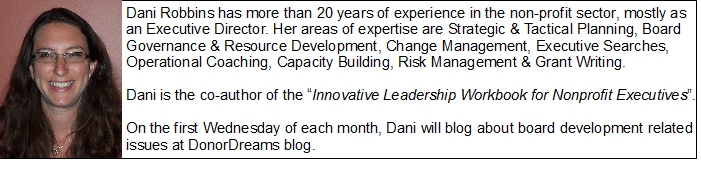
 Every once in a while this job allows me to do something fun and amazing. Last week was one of those times. During an organizational assessment project, I had a brush with history when one of my interviewees turned out to be Nate “Bobo” Smalls. Who is this guy? Quite simply, Bobo is one of the last remaining baseball stars from the Negro Baseball League, which is a piece of history that the world tries very hard not to remember or honor. I walked away from my interview with Bobo with goosebumps on my arm.
 Bobo recalled every neighborhood having at least one mentor.
 The epiphany
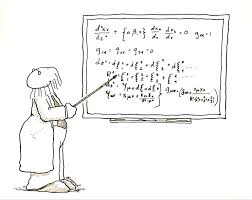 It seems like I’ve been on the road a lot this month, and this allows me to interact with all sorts of talented and amazing non-profit professionals. In fact, just last night I was at dinner with another non-profit consultant who shared with me his “formula” for a successful board volunteer.
 The human element