
 For the last few decades, I’ve been on a quest to become more productive with the time I’ve been given. My counselor introduced me to the idea of mindfulness, meditation, and breathing exercises. Microsoft introduced all of us to Outlook, Word, Excel and PowerPoint. David Allen and Stephen Covey introduced us to time management strategies, tools and techniques.
Truthfully, all of these things have helped make me a more productive person, but I’m still looking for the holy grail.
Why?
I’m not sure. It could be a loose screw in my head. Or could it be that 24 hours in a day is simply not enough? Perhaps, it is most likely that as I get older life feels like it is going faster and faster with more balls to juggle and plates to spin.
With all of this going on in the background of my life, I was drawn to the question Beth Kanter posed in her January 2015 Nonprofit Blog Carnival call for submissions post:
How are nonprofit folks strengthening their personal productivity online muscles in 2015?
I’m dividing this post into two sections. First, I want to talk about some of the new things I’ve been pursuing online to boost productivity. Second, I will talk about what I am doing off-line to tame the online beast that I’m feeding.
Online productivity
 On March 28, 2012, I published a blog post titled “Getting your ducks . . . er . . . volunteers in a row“. I talked a lot about various online services and software I had started using to work with volunteers such as Doodle, Google docs, GoToMeeting, etc. However, it was clear that I had fallen in love with an online project management service called Basecamp.
For the last few years, I’ve exclusively used Basecamp to work with my non-profit and executive coaching clients. It is intuitive and easy to use. Its functionality simply falls into the following areas: shared calendar, task list, documents file cabinet and writeboards.
I know this service fills a need in my non-profit clients’ professional lives. I know it because I’ve seen some of them continue their usage of Basecamp after our engagement ended. As our lives get busier and busier, Basecamp provides non-profit professionals and volunteers a virtual online space where they can collaborate and get work done without having to call another in-person meeting.
With all of this being said, I’m no longer convinced that Basecamp is the end all and be all of online collaboration services. A few weeks ago one of my clients asked me to look into Microsoft’s SharePoint and, much like Alice, I seem to have fallen down a rabbit hole.
Since the end of December, I’ve sunk time into:
- watching YouTube videos about SharePoint
- reading the book “Office 365 in Business” by David Kroenke and Donald Nilson
- reading the book “SharePoint 2013 for Dummies” by Ken Withee
- speaking with friends who use SharePoint in their office
Embarrassingly, I must admit that I’m still trying to wrap my head around what exactly SharePoint is and how to use it. I’m not a “tech-dummy,” but the functionality of this software/service is huge. In the interest of brevity, here is how Ken Withee summarizes the question of “What is SharePoint?” on page 40 of the Dummy’s Guide book I just referenced:
“Officially, Microsoft represents SharePoint as a “business collaboration platform for the enterprise and web.” SharePoint is a platform from Microsoft that allows business to meet their diverse needs in the following domains: collaboration; social networking; information portals and public websites; Enterprise content management; business intelligence; and business applications.”
In other words, it does A LOT and it is complicated. 🙂
I’ve concluded that the 21st Century will be a time of online evolution for non-profit organizations in the area of productivity and collaboration. In just the last few years, I’ve personally seen it with my clients as some embraced Basecamp and now others appear to be checking out SharePoint.
If you are one of those non-profits investigating Basecamp versus SharePoint, I found this awesome compare/contrast page created by TrustRadius. This is definitely worth the click!
Please scroll down and use the comment box to share some of your thoughts and experiences regarding Beth Kanter’s January 2015 Nonprofit Blog Carnival question. We can all learn from each other!
Offline productivity
 I remember it like it was just yesterday. In 2006, I started a new job working for a national non-profit organization providing resource development capacity building services to local affiliates. On Day One, I received my first ever “smart phone,” and I thought I had died and gone to heaven.
It was a Palm Treo (you never forget your first true love). 😉
Since that time, I’ve gone from a Treo to a Blackberry to a Motorola Droid Razr to a Nexus 6 (Google’s first attempt at manufacturing a phone after buying Motorola Mobility).
My love of these mobile devices is rooted in the idea of 24/7 connectivity, which makes me feel more productive. However, my love affair has ended, and I’m starting seeing these little hand-held devil boxes as a ball-and-chain that adds weight to my work-life-balance challenges.
As I said in the beginning of this post, I started working with a counselor almost two years ago. Without getting too personal or entering the realm of TMI, let me just say that I’m working on stress and anxiety reduction strategies that include mindfulness, breathing and meditation.
As online services provide non-profit professionals greater levels of productivity, the price many of us likely pay is stress, anxiety, conflict, and loss of balance. Ironically, all of these things place a drag on our productivity. LOL
For those of you looking for resources and advice about stillness and meditation, I suggest checking our Russell Simmon’s book “Success Through Stillness: Meditation Made Simple“. It is an easy read and a wonderful place to start.
In the end, I believe you need to blend online and offline strategies to move the needle on your personal and professional productivity.
What are your thoughts? Please share your experiences in the comment box below.
Here’s to your health!
Erik Anderson
Founder & President, The Healthy Non-Profit LLC
www.thehealthynonprofit.com
erik@thehealthynonprofit.com
http://twitter.com/#!/eanderson847
http://www.facebook.com/eanderson847
http://www.linkedin.com/in/erikanderson847


 In my last two blog posts, I talked about a USA Today article from John Waggoner titled “
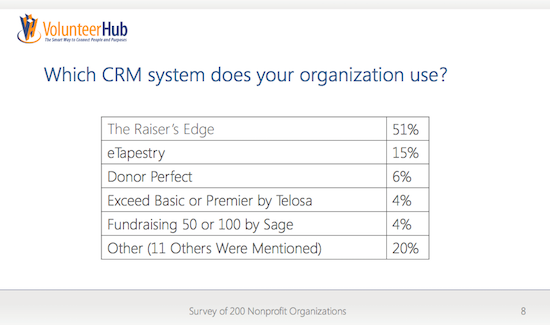
 A few days ago, I reviewed a PowerPoint training on a fundraising website that I run for a client. I stumbled across the following startling statistics pertaining to volunteer management:
 Then, he launched into a story about the importance of what he called “sacrificial giving” and “giving until you can feel a little pinch in your wallet.” The following are just a few of the reasons I recall from that conversation why it is important to give until it hurts:
 Your strategy doesn’t have to be complicated. In fact, the following is a simple upgrade strategy that one of my former employers put together:
 As a donor, I discovered long ago that if I want to make a large contribution to a non-profit organization it probably won’t happen by writing one large check. While some people on this planet have that capacity, my bank account balance isn’t fat enough to do something like Bill Gates or Warren Buffet. However, “large contribution” is a relative term, and I made my first meaningful, sacrificial gift at the age of 27 when I pledged $1,000 to a local Boy Scout council while earning $27,000 working for that same organization.
 The United Way figured this one out a long time ago, didn’t they?
 Since the Great Recession of 2008, many non-profit organizations have explored and developed monthly giving programs. This strategy has been very popular with European charities, and it is akin to the “set it and forget it” mentality of our society.
 Happy New Year, everyone!
 Happy Holidays, DonorDreams readers! It is Christmas morning and my inner child woke me early. I’ve been sitting on the couch, enjoying a silent cup of coffee, and waiting for everyone to wake up.
 On Saturday, I attended the funeral of my father’s aunt —
  He first started looking for people who had once been loyal supporters but for whatever reason stopped donating. Then he found mutual friends (e.g. board members, former board members, volunteers, donors, etc) and asked them to assist with a re-introduction. On a go-forward basis he simply engaged in relationship building.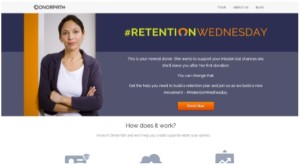
 So, I guess I’m feeling a little bah-humbug about the entire idea of #RetentionWednesday. If I were king for a day (a scary thought), I would decree 2015 “The Year of Retention“.
 I was on the phone yesterday talking with
  Our United Way friends totally get an A+ on this one because they’ve been running around for a decade now telling us to LIVE UNITED which encompasses the following ideas:
 My first Boys & Girls Club national conference was in New York City in 2001 literally months before the terror attacks.
 Fast forward to one of my first engagements as an external consultant. I was assisting with an organizational assessment and conducting interviews with board members, volunteers, collaborative partners, donors, former donors and various other stakeholders.
 I often find myself standing in parking lots after meeting “kicking stones” with staff, board members, volunteers, etc.