
 You know what Douglas Adams says (according to Brainy Quote). . . “If it looks like a duck, and quacks like a duck, we have at least to consider the possibility that we have a small aquatic bird of the family anatidae on our hands.” This quotation kind of sums it all up when I hear non-profit staff complaining about how disengaged their board members are, while they are in the middle of sending out another long email to those same board volunteers.
Let me start by telling you that I am one of the biggest offenders of overusing email. Guilty as charged! I need to seek help, but they say the first step in getting better is admitting you have problem.
My good friend (and former supervisor) used to remind me constantly that he believed email should be used as an “information tool” rather than a “communication tool“.
I spent many years contemplating this advice.
In the final analysis, he was saying email should be compared to snail-mail and the United States Postal Service. Email is like a stamp that you’re putting on a letter. He would advocate using email to send a document, but don’t use it to engage someone in a conversation about something.
I can almost hear him saying: “If you need to engage someone in something, then pick-up the darn phone!”
Of course, I don’t see this issue as being quite so black and white. Email technology has made tasks like coordinating meetings and answering simple questions really easy. So, I guess I don’t completely agree that email is only good for sending out agendas, meeting notes, etc.
HOWEVER . . .
Many of us are overusing email and doing so in ways that result in disengagement. I understand this is a serious assertion, but stay with me on this one.
 When I look at my email inbox, I do a lot of scanning. I first look at the names of people who sent me something. As I do this, I am deleting anything that vaguely looks like spam or advertising. I don’t even open it. After this first purge, I re-visit those who are left standing and start looking at subject lines. I’m essentially trying to prioritize what I should open first versus leave for later when I have more time. And when I say “leave for later,” it could be days or weeks later.
(Confession time: at the time of this post, I currently have 1,027 unopened emails . . . I am truly embarrassed.)
I suspect some of you do the same thing. (Of course, de-nial isn’t just a river in Egypt as the old expression goes)
I also suspect that many of you are sending emails of all sorts to your board members’ work email address.
Finally, I am willing to bet that many board volunteers prioritize their work emails ahead of anything they get pertaining to their volunteer commitments. It is just a guess, but I think I’m on solid ground.
So, what just happened? You were put on the back burner regardless of how important you think your email might be.
In today’s fast paced world, I believe the technology revolution has created a new set of assumptions around communications:
- If something is very important, it warrants a face-to-face meeting.
- If something is pressing or needs to be discussed, it gets done by phone.
- If something isn’t time sensitive, it gets put in an email or a snail-mail envelope.
Am I over-simplifying? Maybe, but then again I don’t think I’m too far off.
If you’re still with me, then it is hard not to conclude that sending lots of emails to your board members is the equivalent of sending them lots of unimportant stuff.
Choosing how and what and when to communicate with your board volunteers is important.
If you want to be relegated to the back burner of a board member’s email inbox, then keep sending those emails.
Here’s a suggestion . . .
- Look at your board roster and select the names of your three most influential board members.
- Sort your email outbox by name/email address
- Count how many emails you’ve sent to each of those board volunteers.
- If you’re averaging more than one per week, then you may want to re-examine how you communicate with them.
You may want to do a quick inventory of what you’re emailing board members. Once you develop a list, set-up informal policies for yourself on what is acceptable to email, what should be a phone call, and what needs to be done in-person.
The following are a few suggestions that I have:
- Distribution of agendas and meeting notes — email
- Checking in to see if a board volunteer completed something — phone
- Getting buy-in from board volunteers on something — meeting
- Coordinating calendars for a meeting — email
- Checking to see who is still coming to a meeting (e.g. quorum call) — phone
- Circling around to a board volunteer who was expected to make a meeting but didn’t show and needs to be “in the loop“– phone (possibly even a meeting over a cup of coffee)
There are lots of times that we shouldn’t be using email, but unfortunately we do it because it is convenient. If you have a moment, I suggest you read a wikiHow article titled “How to Know when Not to Use Email“. It is definitely worth the click!
Do you overuse email? Are you seeking a support group like me? LOL What are you doing about it? Can you add to the list above regarding when it is OK to use email vs. phone vs. in-person meetings for various communications with board volunteers? Please scroll down and use the comment box to share. Your kindergarten teacher would be proud of you. 😉
Here’s to your health!
Erik Anderson
Founder & President, The Healthy Non-Profit LLC
www.thehealthynonprofit.com
erik@thehealthynonprofit.com
http://twitter.com/#!/eanderson847
http://www.facebook.com/eanderson847
http://www.linkedin.com/in/erikanderson847
 Welcome to O.D. Fridays at DonorDreams blog. Every Friday for the foreseeable future we will be looking at posts from John Greco’s blog called “
 One of the pre-test questions that tends to trip people up is whether or not the board has a responsibility to “oversee the CEO“. Believe it or not, it isn’t uncommon for one-quarter to one-third of board volunteers to say “NO“.
 So, maybe you don’t know where to start?
 I was reviewing some old non-profit board governance material this morning and came across a document talking about “trends in non-profit governance“. In other words, the person who wrote that paper thought s/he was able to predict the future. Of course, this document was written more than 10 years ago, which got me thinking it might be fun to review some of their trends and determine where they were right or wrong.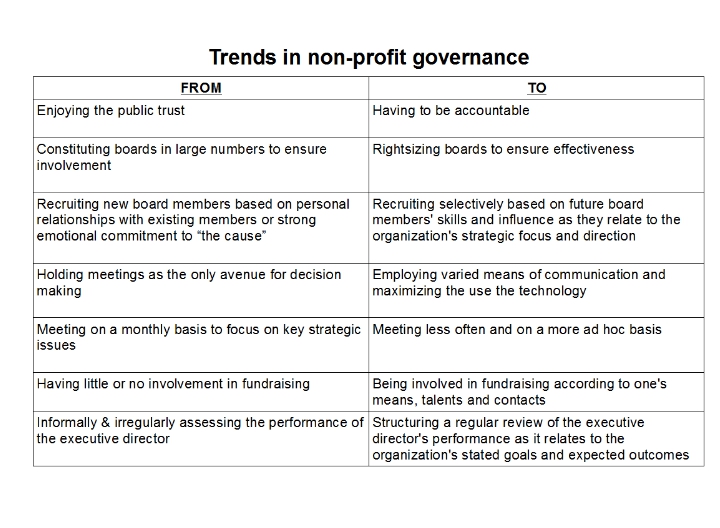
 Over the years, I’ve met non-profit board volunteers who didn’t see value or the need for staff. Likewise, I’ve met countless numbers of staff who complain about their board members. I’ve also met executive directors who deliberately do things to disengage their board volunteers (e.g. taking on fundraising responsibilities, reducing the number of board meetings, etc).
 Welcome to part four of our five part series on Governance. We have already discussed the Board’s role in
 Board member engagement is a common thread running through many of my blog posts. This isn’t because I’m a broken record. The fact of the matter is that so many of the things that plague non-profits are simply “symptoms” of a bigger problem. Yep, you guessed it . . . the root cause of many of our challenges in the can be traced back to our boards.
 Last week a dear non-profit friend of mine from California couldn’t sleep. She tossed and she turned. Ultimately, she got out of bed, turned on her computer and started talking into a microphone. When I woke up in the morning in my bed in Elgin, Illinois, there was an email sitting in my inbox with a voice file attachment. Her words have tumbled around in my head for a week, and I’ve decided to enlist your support in dissecting them.
 After listening to my friend’s recording, I started Googling around and searching for anything that anyone might have written about characteristics and traits of effective boards. I was especially intrigued by her question about incorporating personality testing into the board development process. After all, many workplaces are incorporating this type of assessment into their employee hiring process.
 Competencies
 When I engage non-profit organizations in board development related issues, it can be like simultaneously operating in two parallel and polar opposite universes. One universe exists where everyone is talking about how things are “supposed to be” done. This is described in the agency’s written board development plan. In the other universe, there are board members and staff sitting around a table talking about “some guy” they know without any discussion about board composition gap assessment, prospect lists, prospect evaluation or anything that sounds like process.
 With this in mind, I am reminded of an old “Mondays with Marissa” post from a year ago titled “
 Welcome to part three of our five-part series on Governance. We have already discussed the Board’s role in
  I recommend organizations have the following policies:
 Policies address today. Plans take you into the future.
 The audit is prepared by an independent accounting firm in an effort to assess if the organization is operating in accordance with Generally Accepted Accounting Principles (GAAP) and also within their commitments. Different audits are required based on the amount of government funding that is received. The costs of such audits vary depending on the budget size, revenue streams, and also the quality of the financial systems and the need to for the auditor to clean up those systems.
 Finally, as part of meeting their fiduciary responsibility, the Board should understand how the programs tie to the mission, the number of people served in those programs as well as the impact of that program.