
 A few years ago I noticed some of the letters being sent to me by non-profit organizations were getting less wordy. In fact, these next generation donor communications pieces were mostly featuring a big photograph of someone/something that was supposedly mission-focused.
At first, I really didn’t like this new approach to donor communications. Don’t get me wrong . . . I disliked the blah-blah-blah letters. Like most readers, I would read the old solicitation letters like this:
- Salutation (e.g. did they spell my name right?)
- First few sentences (e.g. how much do they want and what’s the case for support this time?)
- Skip to the signature (e.g. do I know the person who signed the letter?)
- Post script (e.g. don’t know why, but I always read the P.S.)
- If this five second review hooks me, then I’ll go back to the beginning and start skimming (honestly probably paying more attention to bullets, highlighted text and anything in bold/italics)
It was even worse with gift acknowledgement letters, which I would read like this:
- Salutation (e.g. did they spell my name right?)
- Did they get my pledge or gift amount right? (e.g. this is for the IRS and I can’t afford an error)
- Is there a personal notation on the letter (e.g. did my gift merit a little love or was this just a transaction?)
- Is the boilerplate IRS verbiage about the value of any goods or services being received by me from the non-profit as part of my contribution correctly listed (e.g. as I said earlier . . . I don’t wanna tangle with the IRS)
The first few times I received what I am describing as “next generation donor communication pieces,” I simply didn’t like it because it represented change. It threw me off my reading routine, which is silly reason to dislike something. Right?
However, the first time one of these letters was used to acknowledge my contribution by a local non-profit organization, I was upset for a few reasons:
- In their haste to use as few words as possible, they got wrong the boilerplate IRS verbiage about the value of any goods or services being received (this was a technical error)
- I felt slighted because it was as if “my gift didn’t even rise to the level of deserving a handful of kind words” (by the way, the letter couldn’t have been more than three or four sentences with a giant cute picture of a client)
And then . . . I changed my mind after recently receiving the following year-end solicitation letter from my alma mater
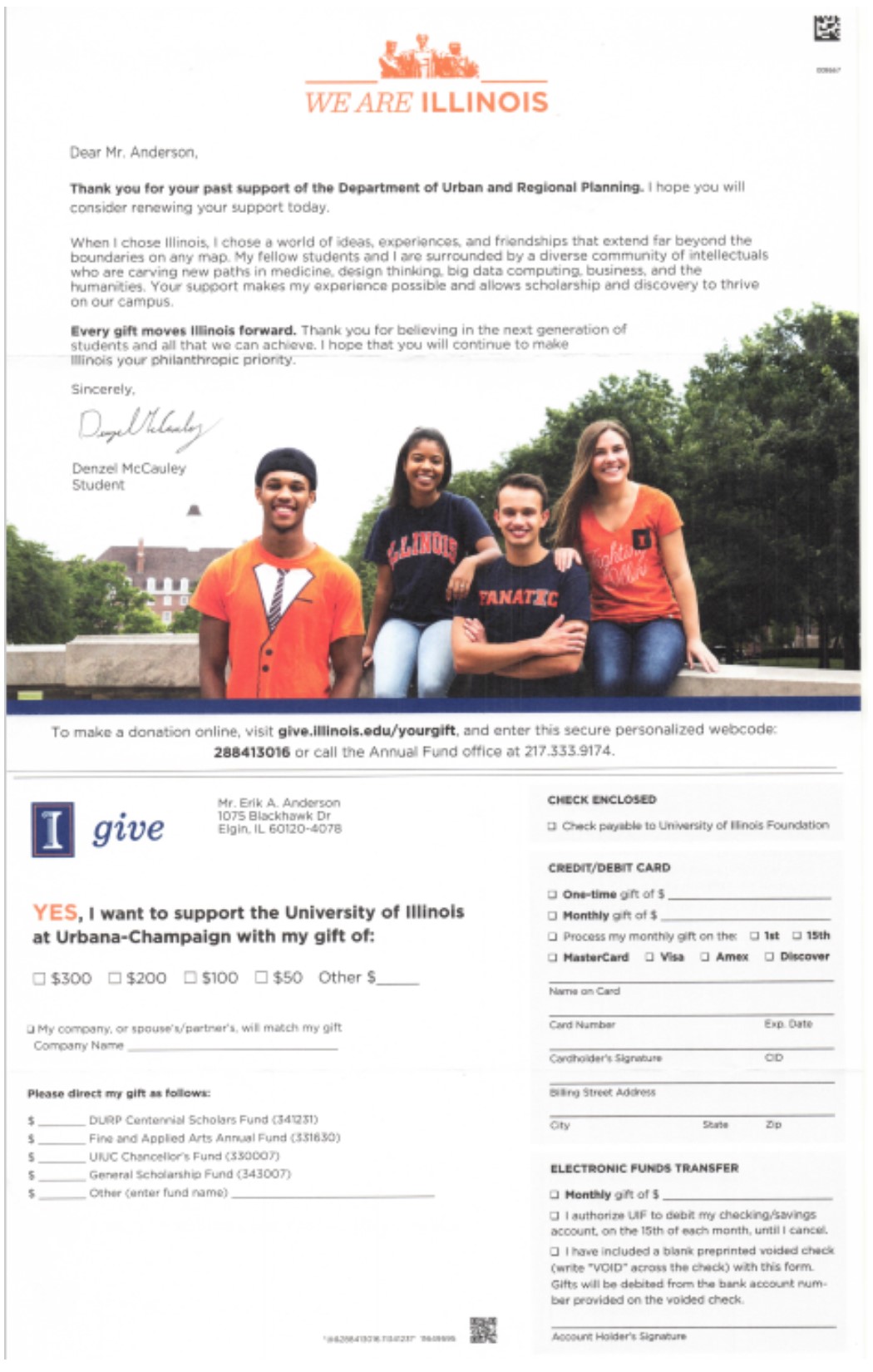
Three short paragraphs. One large picture. Lots of wonky ways to give my money.
Here is what appealed to me and changed my mind about this style of donor communications:
- The picture took me back to my college years. I know exactly where those four students are standing. I’ve stood there before. I suspect that I felt that same way they appear to be feeling. This picture created an immediate emotional connection for me in a way that words never have.
- The logo at the top of the letter also created an immediate emotional connection. It is a picture of the iconic Alma Mater statue. For many students, this artwork at the entrance to the Quad symbolizes many things (e.g. a sense of welcoming, nurturing, school pride, etc). Many students have fond memories attached to this statue.
- The shortened fundraising verbiage cut to the bottom line and the three most important things to me and most other donors: a) the university is grateful for my last contribution; b) my gift made a difference in the life of a student; and c) they want me to continue my support. All three of these messages are emotional in natural (e.g. they love me, they flatter me, they want me back).
- The multitude of choices is appealing (e.g. cash, credit, EFT/ACH, monthly giving options, gift restriction options). This makes me feel “in charge” and not like I’m giving money to a large, faceless organization that is going to do whatever it pleases with my financial contribution. Again, another emotional message (e.g. providing choice implies trust and respect in our society)
I’ve been a fan of Tom Ahern for years. I think he is one of the smartest donor communications experts in the field. In his videos and e-newsletters he often takes about the the six most powerful emotional triggers that marketers use to get people to do “something” like purchase a product, vote for a candidate, make a charitable contribution, etc.
Just in case you’re wondering, here are those six emotional triggers:
- anger
- exclusivity
- fear
- flattery
- greed
- guilt
Tom also talks about the 13 strongest words used by marketing professionals. Here is a list of those words:
- discovery
- results
- proven
- early
- safety
- free
- save
- guarantee
- new
- money
- health
- YOU
I love Tom, but I do cheat on him from time-to-time by reading other donor communications and direct mail experts like Mal Warwick. 😉
The following are five positive triggers that marketers use to emotionally move us to do something:
- hope
- love
- compassion
- duty
- faith
As you review these lists of emotional triggers and powerful words offered by some of the smartest thought-leaders on this topic, can you identify which trigger the University of Illinois wove throughout its letter? Can you see how they did it? If you look really hard, you’ll be surprised at how much more is actually going on in this very short and powerful letter.
Please use the comment box to share your thoughts and observations. We can all learn from each other.
Here’s to your health!
Erik Anderson
Founder & President, The Healthy Non-Profit LLC
www.thehealthynonprofit.com
erik@thehealthynonprofit.com
http://twitter.com/#!/eanderson847
http://www.facebook.com/eanderson847
http://www.linkedin.com/in/erikanderson847
 A few weeks ago I was reading my friend Jay Love’s Bloomerang blog post titled “
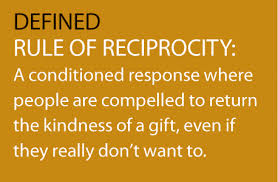
 Just the other day, I found myself in a boardroom facilitating a training on how to make a textbook-perfect, face-to-face solicitation. Discussion topics focused on all the usual suspects including fears, begging, best practices for getting on someone’s calendar, the 12-step process for making the actual ask, etc etc etc. However, at the end of the training and facilitated discussion, one board volunteer asked the following question:
 Over the years, I’ve heard volunteers say all of the following things when trying to fundraise:
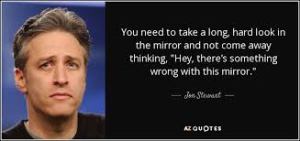 If your board is resistant to the idea of fundraising, I encourage you to first take a good hard look in the mirror and ask yourself the following questions:
 Let’s face it. Our government is broke. We The People have accumulated almost $20 trillion in debt. As government leaders wrestle with this issue, the non-profit sector continues to rally from time-to-time insisting every other sacred cow in the tax code should be scrutinized except for our own. Putting aside the fairness and hypocrisy questions, I’m left wondering: 1) why do we cling to this entitlement so strongly, 2) what is the real effect of this tax policy on our sector and 3) what would really happen if lost this tax status?
 I don’t want to muddle this point. So, let me be clear. I’ve spoke with many donors (both large and small) who mention the word “tax deduction.” It is usually in reference to needing documentation for their accountant. Only one donor actually pushed the pencil and said he needed to make a donation of a certain size to
  I am not a fortune teller. I cannot predict the impact of such a policy change. However, I can confidently say a few obvious things:
 As a young non-profit professional, who was just learning his craft, I was first introduced to the idea of a “house party” event format as a fundraising technique. The idea was simple. Ask someone to host a small party in their home. Work with them to identify a guest list of potential donors from their list of friends and colleagues. Make a group ask during the get together and collect pledge cards. My former employer used to call these “leadership circle” events.
 Last week’s experience helped me see house parties in a whole new light. No longer was this strategy simply a tool in a non-profit person’s resource development toolbox. The more I thought about it, the opportunities seemed to be endless. Here are just a few of my thoughts:
 Oh, well let me count the reasons . . .
 I have no idea why this is so scary for so many non-profit staff and board volunteers. It doesn’t have to be a confrontation. Here are a few talking points:
 If the reasons given by your board volunteer aren’t things beyond anyone’s control (e.g. family member illness, work-related challenges, etc) and they simply don’t feel comfortable with solicitation, then ask them to get heavily involved in cultivation (e.g. engaging new prospective supporters) and stewardship (e.g. showing existing donors gratitude and return on investment) activities. (Note: don’t simply let them focus on other non-fundraising activities like programming or marketing)
 Sometimes we can’t fix the problem. Board members are people, too. Their parents get sick. Their marriages falter. They end up with a new boss who demands more from them.
 Have you ever stopped whatever you doing, took a deep breath, and observed the world around you? (And I mean really take a deep look.) I did this just the other day, and what I saw kind of surprised me. Everywhere I looked I saw
 If I’ve seen it once, I’ve seen it over and over again. An organization puts the right people around the table and engages everyone in developing the right written plan for their fundraising campaign or event. They recruit the right people in the right way to work pledge cards or solicit event participants or secure sponsorships. They even go about assigning prospects/donors to volunteer solicitors very effectively. And then it happens . . . solicitation materials are distributed and everything comes to a screeching halt.
 A report meeting is simply a face-to-face meeting of volunteer solicitors, who come together to report their progress to each other.
 If you’ve recruited the right volunteers with the right skill sets and experiences to work on your fundraising campaign, then these people are likely very busy.
 We need to keep in mind that no one likes fundraising just for the sake of getting their friends to give them money. The reason volunteers sign-up to do what many people consider difficult and intimidating is because they are truly bought into your mission.

 Last week, British voters stunned the world in a number of different ways. First, they voted in a non-binding referendum to invoke
  Communications experts refer to this experience as “
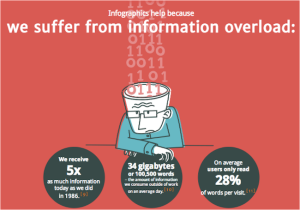 So, if you are still with me, you might be wondering what can be done to improve the likelihood that donors, board volunteers and staff are hearing (and understanding) what your organization needs them to know. While I am not a communications expert, here are a few thoughts: