
Non-profit blogging: What’s In It For Me?
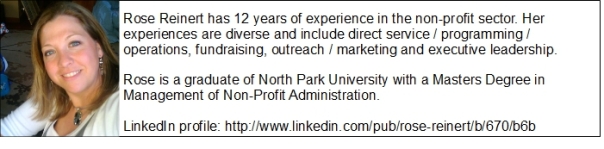
By Rose Reinert
Guest blogger
 Last Monday, we explored chapter 5 of Lon Safko’s book “The Social Media Bible” and talked about how online forums might be helpful to your non-profit organization’s fundraising program. This week, we explore chapter 6 where Safko unpacks the history and power of blogs.
A little history
As we discovered last week, online forums or communities became public in the 1990’s. Using various online communities, people posted to bulletin board systems and forums. People started posting online diaries or journals that documented their personal activities to these sites, and they often included pictures and video. In the late 90’s and early 2000’s, blogging began to move from personal diaries to include other topics.
If you are reading this- you can check “reading a blog” off your bucket list!
The very first guest blog that I posted on the DonorDreams platform addressed the key issue that all readers address every time they open an email, visit a website or visit a blog. Of course, it is the question of “What’s in it for me?” (aka WIIFM). What’s cool about today’s post is that we’re going to discuss WIIFM with regards to both reading a blog and writing a blog.
WIIFM? – Reading Blogs
We all know there is only so much time in the day, and while we work to fulfill our day-to-day job duties, it remains challenging to also fit in personal development and staying up-to-date on industry trends. Who has time for trainings and conferences?
There is an easier way!
I recommend hitting the web and taking a look at some blogs that speak to your profession.
Select a few that you can remain committed to reading. Subscribe to those blogs, and content will be delivered to your email inbox as frequently as the blogger publishes. Some bloggers write a monthly post, others do it weekly, and some (like our friend Erik Anderson at DonorDreams blog, try to post something every day).
My suggestion is to set aside about ten minutes into your schedule at the beginning of your day when you’re powering up your computer. Dedicate those 10 minutes to your professional development by reading a blog or two that you’ve subscribe to and speaks to your professional interests.
If you are not sure where to start you can ask colleagues about some of their favorites. Here is a short list of blogs that I suggest you check out:
- Joanne Fritz: about.com’s Nonprofit Charitable Orgs
- Dani Robbins: answers.com’s Nonprofit Pages
- Beth Kanter: Beth’s Blog — How Networked Nonprofits Leverage Networks and Data for Social Change
- The Agitator — Nonprofit Fundraising & Marketing Strategies, Trends, Tips with an Edge
- Jeff Brooks: Future Fundraising Now
- Lon Safko, Author, Speaker, Strategist, Futurist
For more suggestions, please check out the Blogroll section of the DonorDreams blog. If you have suggestions of other blogs to add to blogroll, please use the comment box to share your suggestion and Erik will add them to our online community. (Isn’t he always saying something like: “We can all learn from each other?”)
 WIIFM?—Writing a Blog
This is the first time that I have ever blogged. I did one or two guest spots here on the DonorDreams blog platform, but this is the first ongoing guest spot that I have had.
The first several times that I sat down to write- I ended up:
- stopping and doing the dishes
- making a phone call to my mom
- writing a little . . . erasing it
- playing a game with my kids
- finally pushing through to finish
Much like anything, with practice, it becomes less intimidating and each time I sharpened that skill a little more.
Any time you enhance communication with your donors or supporters, you continue to build trust. Depending on how you structure your blog contents, a blog can:
- engage donors
- keep them updated on news
- align your organization with national trends or initiatives
- demonstrate how your organization is working to meet needs and solve problems.
If your agency is striving to become a donor-centered organization, your blog content should be focused on:
- appreciating and expressing gratitude to donors
- showing donors that you are using their investments how you said you would during the solicitation visit
- illustrating the impact that contributions are having on the lives of your clients and throughout the community
Blogging is a great way to show relevance within your industry. I believe that anytime you can differentiate your organization as an expert in a certain area, you build trust and accountability.
Are you thinking about starting a blog? If so, don’t just jump in and start blogging this afternoon. Ensure you are committed to the time it takes. Make sure your dedication to consistently blogging is a sustainable commitment. The worst thing to do is start with a bang and fizzle out.
So, now it’s your turn. I would love to hear more about your experience blogging. If you don’t blog, then please tell us the comment box to tell me about your favorite blogs.
Does your organization currently use blogging? If so, who is the target audience? Share your ideas for blogging for your organization. Do you think blogging is worth your investment of time?
 “I regard it in fact as the great advantage of the mathematical technique that it allows us to describe, by means of algebraic equations, the general character of a pattern even where we are ignorant of the numerical values which will determine its particular manifestation.”
 (I feel compelled to counter a possible negative perception of this last point by noting that isn’t it a very good thing if a manager sees when an associate or team is struggling, and at the right time and in the right way enters the picture and provides just the right amount of help to get back on the right track? Less freedom is not always a bad thing!)
 I look forward to seeing the ones that you’ve run across!
 Twas the day after Christmas and all through the house, everyone was sleeping except for me. The reality is that I’ve not blogged in two days because of a deadly combination of holiday festivities and a horrible case of bronchitis. So, this morning I’m sitting at my computer and cleaning out my email inbox looking for blog ideas. There are scraps of ideas everywhere I look, but nothing cohesive was coming together until I opened an email from Tom Ahern, who is one of the biggest and brightest names in the field of donor communications.
 I’m not sure about you, but every time I’ve experienced donors remorse, it has been because I made a contribution out of a sense of obligation. Here are a few examples:
 There are several benefits to engaging your donors in an on-line forum:
 An African farmer heard tales about people who had made millions by discovering diamond mines. These tales so excited the farmer that he could hardly wait to go prospecting for diamonds himself. He sold the farm and spent the rest of his life wandering the African continent searching unsuccessfully for the gleaming gems that brought such high prices on the markets of the world. Finally, worn out and in a fit of despondency, he threw himself into a river and drowned.
 Jerry, the financial analyst, can make a mean bouillabaisse. Mary, the executive admin, is a Toastmasters organizer. Julie, in inside sales, does graphic design for her church’s marketing pieces. Peggy, in tech support, is a stand up comedian. Bill, in logistics, does resumes on the side for family and friends. Susan, in customer support, is on the board of a local non-profit. Judy, a software tester, volunteers at the local hospice. Christian, a call center agent, paints. John, an industrial engineering manager, blogs. Damian, a research analyst, is an actor in a local drama troupe.
 If I’ve heard it once, I’ve heard it hundreds of times . . . non-profit board volunteers and staff hate strategic planning. Why? The reasons are all over the place, but some of the more popular reasons given are:
 I was running a Boys & Girls Club in Texas, when I was offered the Executive Director position for the Boys & Girls Clubs in Akron, Ohio. I knew the President of the Akron Community Foundation and not another soul in town. Thankfully, my Board had a plan.
 Program officers of foundations are incredibly generous with their time and are interested in learning about your organization. Community leaders, by definition, care about the community. Go talk to them. You will be pleasantly surprised by the number of people who say yes to your request for a meeting.
 Figure out the “must attend” event in town, and attend. And when you do, walk around and greet everyone, introduce yourself to people you haven’t been able to get in front of and ask if you can call them for a meeting. Again, you’ll be surprised at the number of people who say yes.
 Sometimes I think the universe speaks to us, and lately it has been begging me to write this blog. Over the last few months, I’ve spoken with a good handful of non-profit professionals who have shared stories of scandal and crisis that would make your toes curl. These stories have ranged from incidents on the front line that made the local newspaper to outright embezzlement.
 For the record, I agree with my United Way friends. If you don’t know about
  You can probably spend the rest of your life writing policies, but let’s not get carried away. Here are a few questions I suggest you ask as you start going down this road:
 Once someone plops on your home page what do they see? Is it mobile friendly? Can they easily navigate it?
 Does mobile friendly really matter?
 That July afternoon in Coleman, Texas was particularly hot — 104 degrees according to the Walgreen’s Rexall’s thermometer. In addition, the wind was blowing fine-grained Texas topsoil through the house. But the afternoon was still tolerable; even potentially enjoyable. A fan was stirring the air on the back porch; there was cold lemonade; and finally, there was entertainment. Dominoes. Perfect for the conditions. The game requires little more physical exertion than an occasional mumbled comment, “Shuffle ‘em,” and an unhurried movement of the arm to place the tiles in their appropriate positions on the table. All in all, it had the makings of an agreeable Sunday afternoon in Coleman. That is, until my father-in-law suddenly said, “Let’s get in the car and go to Abilene and have dinner at the cafeteria.”
 My first exposure to this story was as I was unknowingly about to experience it…