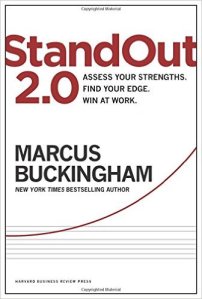
 As I said in my last post titled “New year starts with a little assessment work,” I’m beginning the new year by gifting myself 12 weeks of assessment. By assessment, I am looking closely at both personal issues (e.g. strengths, weaknesses, likes, dislikes, etc.) and business issues (e.g. productivity, profitability, travel habits, types of contracts that bring me joy/fulfillment, etc). All of this will lead to planning exercises including direction setting/visioning, goal setting, strategies and tactics.
In my last post, I confessed to experiencing difficulty with the personal assessment side of my journey until I ran across two books — StandOut 2.0 and Emotional Intelligence 2.0 — at an O’Hare airport bookstore. Today’s post will focus on the first book, StandOut 2.0 written by Marcus Buckingham, and what I’ve learned as well as how I think non-profit leaders might be able to apply this tool.
This tool is rooted in the the principles of positive psychology and appreciative inquiry, which are fields that have been growing like a weed over the last few decades. You may recognize this author and this approach because Marcus Buckingham introduced the StrengthsFinder assessment in his book titled Now, Discover Your Strengths.
The entire book is based on one simple premise. If you want to excel and get the most out of your team, then you have to focus on maximizing your strengths. Working on shoring up your weaknesses is nice, but it won’t put you in a sweet spot when it comes to productivity, quality, and fulfillment.
There are nine “strength roles” identified in this assessment approach:
- Advisor
- Connector
- Creator
- Equalizer
- Influencer
- Pioneer
- Provider
- Stimulator
- Teacher
In the last week, I have read the book, taken an assessment, and set-up my online work space where I receive weekly tips and set personal goals. It hasn’t felt like a “heavy lift” or hard work.
After taking the assessment, you receive a personalized report ranking your strength roles. Your top two strengths become the focus of your work. The following are my top two strength roles and their descriptions:
- Advisor: “You are a practical, concrete thinker who is at your most powerful when reacting to and solving other people’s problems.“
- Connector: “You are a catalyst. Your power lies in your craving to bring two people or ideas together to make something bigger and better than it is now.“
It is this combination of strengths that makes me unique, and according to Buckingham I will benefit from:
- honing these strengths
- aligning my work and career path with these strengths
- building my team around these strengths
- learning how to leverage these strengths in the areas of client services and sales
Buckingham walks readers through “Three lessons for building your strengths” in chapter three of the book. I finished that chapter thinking his advice was wise and something worth investing my time.
I really like the online work space that comes with this toolbox, including the ability to link other members of your team into the site.
StandOut 2.0 was an exciting discovery for me. I didn’t waste time figuring out ways to incorporate it into my life. Within a few days, I asked one of my executive coaching clients to purchase the book and take the online assessment. We integrated the results into our next session and plan on using it to frame their job search process.
On a personal note, the assessment provided me tons of “food for thought” for my consulting practice. It validated my intuition that I need to work harder at cultivating the executive coaching side of my practice, and it will provide context and a frame for the visioning exercise I plan on undertaking in the next few weeks.
So, you are probably wondering how this assessment tool might benefit you. Here are a few thoughts:
- If you find yourself wondering from time-to-time if you are in the right position at your non-profit organization (and who doesn’t periodically do this), then this tool might help you find clarity
- If you find yourself spinning your wheels at work, then this tool might help you find traction
- If you find yourself struggling with building a powerful, efficient team, then this tool might help you with hiring, project assignment, and how to best manage/coach your direct reports.
Have you used this tool or others like it? If so, please scroll down to the comment box and share your thoughts and experiences. We can all learn from each other.
Here’s to your health!
Erik Anderson
Founder & President, The Healthy Non-Profit LLC
www.thehealthynonprofit.com
erik@thehealthynonprofit.com
http://twitter.com/#!/eanderson847
http://www.facebook.com/eanderson847
http://www.linkedin.com/in/erikanderson847
 Welcome to a new year everyone, which for many people typically means making resolutions and goals. For me, I’ve been telling friends and family for the last few months that I plan on taking the first quarter of 2016 do a little soul searching. I anticipate a few personal and business decisions stemming from my assessment efforts.
 As most of you know, I’ve been traveling A LOT lately and I haven’t had the opportunity to watch a lot of television. However, it seems like every time I have the TV turned on, I’m seeing a television commercial from General Electric (GE) that talks about “ideas”.
 However, there is much, much more to leading change than the simple six step model that some organizational development consulting/training companies teach, and I suspect it has something to do with your organization’s culture. This is where I think all of us can learn from The Walt Disney Company, home of “Imagineering”. (Note: this term is trademarked by Disney)
 It seems like one common theme in my work with non-profit organizations is that “building consensus” is difficult. Getting everyone on the same page can be like herding cats. It was this reality that had me all tied in knots a few months ago as I was sitting down for the first time with my Philanthropy Day planning committee. We had lots of things to decide (e.g. event location, registration fees, training sessions, discussion panels, etc), and there was very little time to do so.
 The people closest to your mission are board and staff members. So, when the organization is short on cash and cannot meet its payroll obligations, it is only natural to ask board members to dig a little deeper.
 Don’t pass the basket and ask smaller, low capacity donors. Identify your larger, more capable donors and schedule an in-person meeting to explain what has occurred and ask for their support.
 Accounts receivable can be any number of the following individuals/entities:
 If your organization finds itself in this mess, then the bank is probably not extending you additional credit. While managing your cash flow on the backs of your vendors is a bad thing to do, sometimes life presents you with a bunch of bad options.
 I belong to a professional association and recently agreed to join their nominating committee to help the board of directors fill a few expiring board terms. This volunteer experience has made “board recruitment” top of mind for me over the last few weeks. I also can’t stop thinking about the various organizational structures and strategies/approaches to board recruitment. When this happens to me, I know there must be a blog post brewing.