
 On Tuesday evening I found myself sitting in front of a group of board volunteers as well as prospects who were contemplating joining the board. What started off as a routine training about basic board roles and responsibilities morphed into a discussion about what makes an exceptional board.
According to BoardSource and other non-profit experts, the following principles go into making exceptions boards:
- Effective partnership between the board and its executive director
- Asking questions and engaging in respectful debates and discussions
- Strategic thinking and vision-focused discussions integrated into board meetings
- Mission-focused and driven with the agency’s mission infused throughout everything it does including fundraising, decision-making, etc
- Transparency in everything the board does with the community understanding all of its decisions
- Independent minded with conflicts of interest constantly being identified and mitigated
- Measuring the agency’s impact and ensuring that outcomes are achieved
- Life-long learners sit around the boardroom table and relish evaluation opportunities and want to learn how to do things better
- Focused on how to engage all board volunteers in securing more resources and linking the organization’s strategic plan to its budget
- Intentional in all of its actions including establishing the size of the board, committee structure, and other various governance questions
- Integrity rooted in an ethics policy, oversight and audit
- Planned turnover in the boardroom supported by thoughtful recruitment efforts
Do you think these things define an exceptional board? Is anything missing? What are the more difficult things to achieve on this laundry list?
Please use the comment box below to share your thoughts and experiences.
Here’s to your health!
Erik Anderson
Founder & President, The Healthy Non-Profit LLC
www.thehealthynonprofit.com
erik@thehealthynonprofit.com
http://twitter.com/#!/eanderson847
http://www.facebook.com/eanderson847
http://www.linkedin.com/in/erikanderson847
 I cannot tell you the number of people over the course of my 20 years in non-profits that either congratulated me for running my non-profit like a business and went on to tell me non-profits should be run like a business. I never knew what to say. Thank you?
 Non-profits have to manage the budget AND meet the mission.
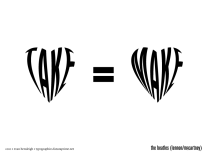
 Non-profits are not run by one person for a reason. The Board represents the community as the owners of the organization. The organization exists to meet a need. Businesses, which also address needs, exist to make money.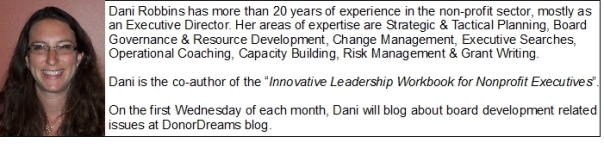
 “I regard it in fact as the great advantage of the mathematical technique that it allows us to describe, by means of algebraic equations, the general character of a pattern even where we are ignorant of the numerical values which will determine its particular manifestation.”
 (I feel compelled to counter a possible negative perception of this last point by noting that isn’t it a very good thing if a manager sees when an associate or team is struggling, and at the right time and in the right way enters the picture and provides just the right amount of help to get back on the right track? Less freedom is not always a bad thing!)
 I look forward to seeing the ones that you’ve run across!
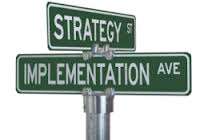 If I’ve heard it once, I’ve heard it hundreds of times . . . non-profit board volunteers and staff hate strategic planning. Why? The reasons are all over the place, but some of the more popular reasons given are:
 Sometimes I think the universe speaks to us, and lately it has been begging me to write this blog. Over the last few months, I’ve spoken with a good handful of non-profit professionals who have shared stories of scandal and crisis that would make your toes curl. These stories have ranged from incidents on the front line that made the local newspaper to outright embezzlement.
 For the record, I agree with my United Way friends. If you don’t know about
  You can probably spend the rest of your life writing policies, but let’s not get carried away. Here are a few questions I suggest you ask as you start going down this road:
 That July afternoon in Coleman, Texas was particularly hot — 104 degrees according to the Walgreen’s Rexall’s thermometer. In addition, the wind was blowing fine-grained Texas topsoil through the house. But the afternoon was still tolerable; even potentially enjoyable. A fan was stirring the air on the back porch; there was cold lemonade; and finally, there was entertainment. Dominoes. Perfect for the conditions. The game requires little more physical exertion than an occasional mumbled comment, “Shuffle ‘em,” and an unhurried movement of the arm to place the tiles in their appropriate positions on the table. All in all, it had the makings of an agreeable Sunday afternoon in Coleman. That is, until my father-in-law suddenly said, “Let’s get in the car and go to Abilene and have dinner at the cafeteria.”
 My first exposure to this story was as I was unknowingly about to experience it…
 Last week I was out to lunch with two male non-profit friends in downtown Chicago when the topic of women board volunteers came up. This happens from time-to-time, and when it does I always bite my tongue because I tend to have strong opinions on this subject. So, I took a deep breath and prepared for what I assumed was going to be one of those “difficult and uncomfortable conversations“. Boy oh boy . . .was I wrong (and pleasantly surprised).
 Sometimes I hear something that hits me just right, and it takes days to get it out of my head. This happened on Tuesday during the Fox West Philanthropic Network’s
  Dani suggested that board volunteers who are “strategic thinkers” will have an easier time making the transition from traditional fiduciary modes of governance to more strategic and generative modes.
 If you’re scratching your head while reading this list and asking “what does THAT mean,” then click the link and read the CEB Blog post. It really is quite good. If you want to learn more, then I suggest you start Googling around. 😉 You also might want to
  Boards meetings can quickly go from productive to destructive in any number of ways. The following are just a few lessons I’ve learned throughout the years and thought board volunteers might benefit from reading:
 When you don’t know where you’re going any road will get you there
 Time of Death: 2 hours after we started talking about this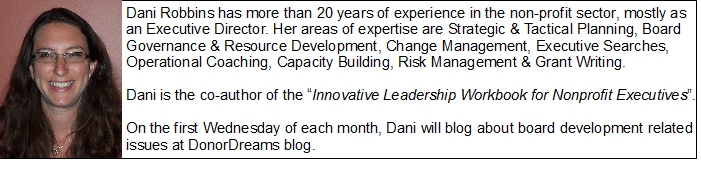
 It seems like I’ve been on the road a lot this month, and this allows me to interact with all sorts of talented and amazing non-profit professionals. In fact, just last night I was at dinner with another non-profit consultant who shared with me his “formula” for a successful board volunteer.