
 I was reviewing some old non-profit board governance material this morning and came across a document talking about “trends in non-profit governance“. In other words, the person who wrote that paper thought s/he was able to predict the future. Of course, this document was written more than 10 years ago, which got me thinking it might be fun to review some of their trends and determine where they were right or wrong.
The following are just a few of the trends that I found interesting:
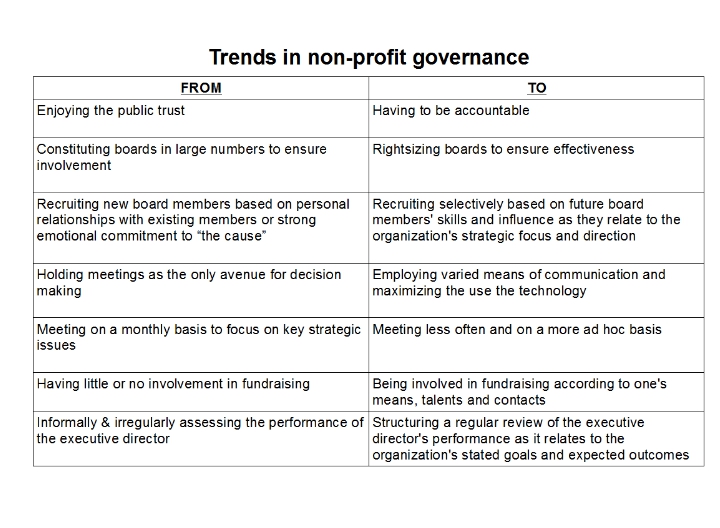
As I review this list, there are a number of thoughts and questions running through my head. Let me spill those things out in the following bullet pointed list:
- How many non-profit board have gotten smaller over the last decade? I wonder how that is going for them? Are they more effective or less effective?
- Wow! They nailed the technology trend. I see many agencies conference calling people into meetings and doing some business via email polling and voting. (Not that I think it is very effective.)
- Huh? The FROM-TO pertaining to fundraising is a little comical. I cannot tell you how many non-profit boards I’ve worked with who are very reluctant fundraising solicitors.
- Really? Once in a blue moon, I run into a non-profit board that has an annual performance evaluation process in place for their executive director. More often than not, I see boards doing everything in their power to NOT evaluate the CEO.
The following are a few interesting resources I dug up online pertaining to some of these trends:
- The Bridgespan Group: “Size of the board“
- blue avocado: “Executive Director Evaluation Survey Form“
- National Council of Nonprofits: “Ethics and Accountability in the Nonprofit Sector“
- The Bridgespan Group: “Recruiting and Vetting Nonprofit Board Members“
- nonprofit hub: “15 Ways to Transform Your Board of Directors into Fundraising Champions“
While clicking around for these links, I came across another great document titled “Emerging Trends in Nonprofit Governance“. It looks like it was presented at the ASAE & The Center’s Annual Association Law Symposium in 2009. This document contains all sorts of best practices, and it is definitely worth the click.
I’m not sure if I would put any of these things under the classification of “trends“. I think most of the trends stuff that I’ve reviewed today can better be described as “best practices“.
So, let me go out on a limb this morning and identify what I see as a real trend in non-profit governance . . .
Serving on a non-profit board will
continue to be difficult and entail hard work!
Duh! 😉
I hope when non-profit bloggers revisit this post a decade from now they will be able to say, “That Erik Anderson really nailed that trend.” LOL
When reviewing the initial list of “trends” that I shared at the beginning of this post, what questions and thoughts initially spring to mind? Has your agency made the “FROM-TO” transition on any of those trends? If so, which ones? Are you currently working on any of those changes in your non-profit governance? If so, which ones and what are you doing to facilitate the change?
Please use the comment box below to share your thoughts and experiences. We can all learn from each other.
Here’s to your health!
Erik Anderson
Founder & President, The Healthy Non-Profit LLC
www.thehealthynonprofit.com
erik@thehealthynonprofit.com
http://twitter.com/#!/eanderson847
http://www.facebook.com/eanderson847
http://www.linkedin.com/in/erikanderson847
 A few months ago, I had a horrible experience with my favorite airline. Long story short . . . delay, delay, delay, delay, loaded on the plane, equipment malfunction, delay, delay and finally up-up-and-away. A whole day was lost. However, in that catastrophe, I was able to learn something about Twitter and the new age of customer service. In the last few weeks, I’ve been reminded of this experience when two bloggers talked about Twitter. So, I thought I’d we’d look Twitter a little more closely today, especially as it relates to non-profit organizations.
 I am on Twitter every day. I’m not there very long. I’m not a Twitter expert. I’m sure that I am doing lots and lots wrong in the eyes of social media experts. However, I do see lots of content and most of those who I’m following are non-profit organizations.
 This is a tough question to answer because I suspect it may vary slightly from agency-to-agency. However, some of the better non-profit organizations are tweeting the following:
 Sometimes I see things at just the right time and in the right place, and it results in me seeing something differently. Usually, when this happens it results in an AH-HA moment. This is exactly what happened to me yesterday when I opened an email from my friends at
  So, the title of today’s blog post had the word “AH-HA” in it, which implies that my friends at Non-Profit Humour inspired a light bulb of some sort.
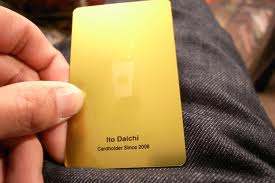 Yes, yes, yes . . . I know what you’re thinking: “Our agency doesn’t have things like hotel rooms, flights and cups of coffee to give away like these for-profit corporations.” But are you sure about that? Because I’ve attended many charity auctions in my life.
 Last week I was out with a friend for a glass of wine after work. We hadn’t seen each other in a few months, and we were catching up on lost time. “How are you? How is the new job? How’s your wife? Kids? Grandkids?” You know the drill. It was during this exchange that he dropped the bomb: “So, how is your partner? Ya know … the only time I ever see him is when he is asking me for a donation.”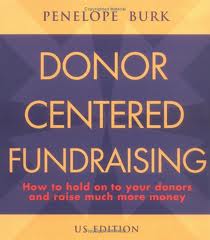
 These personal touches do not have to be all about your non-profit organization. I suggest that you train your volunteers to be less obvious. For example, both stewardship touches could be as simple as three minutes worth of messaging in the middle of a lunch meeting or after-work cocktail. It should feel organic and nature. It shouldn’t feel forced or contrived.
 Welcome to O.D. Fridays at DonorDreams blog. Every Friday for the foreseeable future we will be looking at posts from John Greco’s blog called “
 If I’ve seen it once, I’ve seen it hundreds of times. And I bet you have, too. I will omit the names to protect the innocent.
 We’ve also all seen this situation.
 A non-profit organization that doesn’t invest time and resources into evaluation and critique is akin to an ostrich sticking its head in the sand.
 Over the years, I’ve met non-profit board volunteers who didn’t see value or the need for staff. Likewise, I’ve met countless numbers of staff who complain about their board members. I’ve also met executive directors who deliberately do things to disengage their board volunteers (e.g. taking on fundraising responsibilities, reducing the number of board meetings, etc).
 Welcome to part four of our five part series on Governance. We have already discussed the Board’s role in


 Welcome to O.D. Fridays at DonorDreams blog. Every Friday for the foreseeable future we will be looking at posts from John Greco’s blog called “
 I find this distinction really fascinating, and I haven’t been able to stop thinking about it since I read this post. So, I’ve been focused on identifying some non-profit related “predicaments” and here is what I’ve come up with . . .
 Board member engagement is a common thread running through many of my blog posts. This isn’t because I’m a broken record. The fact of the matter is that so many of the things that plague non-profits are simply “symptoms” of a bigger problem. Yep, you guessed it . . . the root cause of many of our challenges in the can be traced back to our boards.