
 Welcome to the fifth and final part of this ongoing series of posts on how to write your non-profit organization’s annual resource development plan. As I’ve previously mentioned, this series was inspired by how many DonorDreams blog readers were clicking on the “Time to start writing your 2015 resource development plan” post, which I wrote a year ago.
Let’s quickly recap where we’ve been in the last few weeks with this series:
- Writing your resource development plan in steps: Step One focused on the importance of putting the right people at the table
- Writing your resource development plan in steps: Step Two addressed pre-planning activities such as evaluation and assessment
- Writing your resource development plan in steps: Step Three walked readers through writing a statement of fundraising purpose as well as developing both financial and non-financial goals
- Writing your resource development plan in steps: Step Four tackled the issues of developing both financial and non-financial strategies and tactics as well as the importance of creating a fundraising calendar.
Today’s post is all about tying up a few loose ends with regards to process. Enjoy!
Let’s bring this entire series of posts full circle by going back to something I said in both the first and fourth posts, which was:
“S/he who writes the plan, owns the plan. And s/he who owns the plan is the only person who will care enough to implement the plan.”
The Board of Directors
 Please keep in mind that “planning” is a key role/responsibility of your non-profit board. With this in mind, the task force / committee I suggested you recruit in the first blog post does not have the authority to make your written resource development plan “the law of your non-profit kingdom”. Only the board can do so, which means they better have a seat at the planning table and participate.
Of course, the reality of the situation is that asking ALL of your board volunteers to sit down and develop a comprehensive fundraising plan is not likely going to happen. However, it might not need to if your planning process is designed appropriately.
Consider these two scenarios:
Scenario #1: The committee develops the draft resource development plan, and the board uses a planning retreat to become familiar with, discuss implementation, and take ownership of the plan
Scenario #2: As the committee completes various draft sections of the plan, those pieces are included on board meeting agendas where generative discussions are facilitated and board feedback is looped back into the committee’s revision process
Personally, I’ve seen both of these approaches work, and I suspect there are many other ways to engage board volunteers in taking ownership. If you’ve had success with another process, please scroll down and share your experiences in the comment box section of this blog.
The Strategic Plan
 While most resource development plans are aligned exclusively with the organization’s annual budget, it is important not to forget about the strategic plan.
As with everything in life, ideas need money and the same is true for your strategic plan. Make sure that the strategies and tactics in your strategic plan find a place in your annual budget. This way when your annual resource development plan is aligned with revenue side of your annual budget, then everything will exist in harmony.
Another alignment consideration is to make sure the planning committee is knowledgeable of all resource development related strategies and tactics in the strategic plan. This will increase the likelihood that those items will get integrated into this planning document and take a form with more depth and detail.
Alignment isn’t just for cars. It is equally important for organizations, too.
Annual Performance Plans
 Just a few quick words on this subject.
As I mentioned in the previous section about strategic plan alignment, your resource development plan should also align with both your executive director fundraising professional’s annual performance plans.
If you want to increase the likelihood that your plan gets implemented, then hold someone accountable for it.
Kinda simple, don’t you think?
The only word of caution here is that the board of directors needs to understand that alignment at this level doesn’t absolve the board of their role in implementing the plan.
Think of it this way . . . staff support the board who in turn make the plan come to life.
Monitoring & Evaluation
 How many times have your developed a plan, adopted it, put it on your organizational bookshelf, and watched it collect dust? Unfortunately, this is all too often a common occurrence.
There are many ways to keep a plan alive and on track including:
- reports
- dashboards
- scorecards
- post-event / post-campaign critique meetings and evaluation
Before developing any of these tools, it is important to sit down and decided what are the most important things to measure.
When it comes to campaigns or events, the following are a few metrics many organizations appear to track:
- Board solicitation phase – actual vs. goal
- Community face-to-face solicitation phase – actual vs. goal
- Targeted mail solicitation phase – actual vs. goal
- New donor acquisition – actual vs. goal
- Donor renewal – actual vs. goal
- LYBUNT renewal – actual vs. goal
- Individual volunteer solicitor progress – number of pledge cards assigned vs. number of worked & returned cards
With regard to your overall resource development program, the following are a few metrics I’ve seen some organizations track:
- # of donor solicitations
- # of cultivation calls
- # of stewardship contacts
- donor retention / donor turnover (e.g. LYBUNT, SYBUNT, etc)
- goal vs actual on various revenue streams (e.g. grants, major gifts, annual campaign, special events, etc)
Phew . . . this five part blog series has come to a merciful end. Hopefully, your organization is well underway with its resource development planning efforts. Please share your thoughts and experiences in the comment box below. We can all learn from each other.
Here’s to your health!
Erik Anderson
Founder & President, The Healthy Non-Profit LLC
www.thehealthynonprofit.com
erik@thehealthynonprofit.com
http://twitter.com/#!/eanderson847
http://www.facebook.com/eanderson847
http://www.linkedin.com/in/erikanderson847
 Welcome to the fourth part of this ongoing series of posts on how to write your non-profit organization’s annual resource development plan. As I’ve previously mentioned, this series was inspired by how many DonorDreams blog readers were clicking on the “
 Identify all of the fundraising campaigns, events, and activities you plan on doing in the upcoming year. Here are a few examples: golf outing, gala dinner & auction, direct mail, major gifts initiative, annual campaign, grant writing, etc.
 As you recall from the previous post, there is a section of the resource development plan that includes process goals. These non-financial goals could focus on: new prospect acquisition; cultivation activities; donor retention & stewardship; marketing and donor communication; board member engagement; and evaluation and monitoring.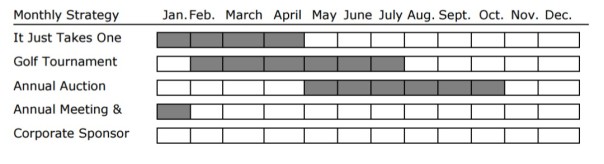
 With your volunteers sitting around the planning table and your organization’s resource development assessment data gathered and digested, it is now time to cast your vision for the upcoming year. This can be accomplished with the following exercise:
 There has to be hundreds of ways to skin this cat, and none of them are incorrect. The following method is very simple, and while it lacks a ton of process, it will get you where you need to go (but feel free to use whatever process best fits your organizational culture):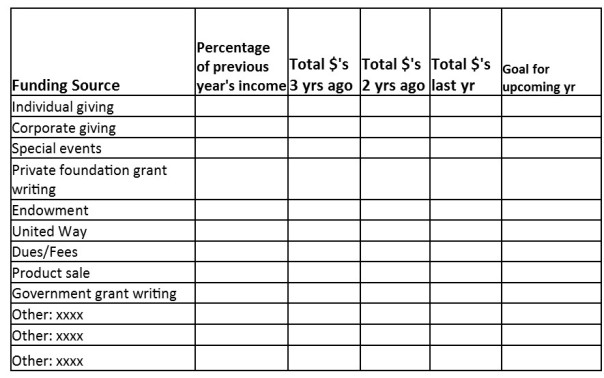
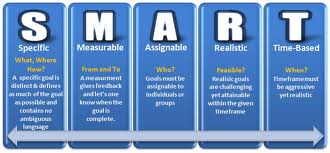 The previous section sets the stage for establishing fundraising event and campaign goals; however, there are non-financial goals your team should also consider. Those non-financial goals could focus on: strategy, leadership, operation, donor relations, marketing and communication, and evaluation and monitoring.
 Now that you have all of the right people sitting around the table, the next thing you want to do is engage the group in assessment activities.
 Resource Development Quality statements
 Other Questions Your Volunteers Will Want Answers To
 A number of years ago, I served on an amazing team of resource development professionals at Boys & Girls Clubs of America (BGCA). Our team’s mission was to provide consulting services and tools to local affiliates to help them increase their individual giving. One of the tools the team created was an online software wizard to assist Clubs with writing their annual resource development plans. While it was an awesome tool, it wasn’t embraced or used by those on the front line.
 You’re busy. I get it! But it will be one of the biggest mistakes of your life if you lock yourself in your office and bang out your organization’s annual resource development plan.
 It is a basic truism for some organizational development professionals that “Culture trumps strategy“. In the last few months, this expression has been front and center in my mind. I guess the reason it bothers me is because of its implications, which is none of what I bring to the table as a non-profit and fundraising consultant matters unless the organization’s culture is ready to receive it and act upon it.
 I’ll stop Googling now. Because I think I get it now.
 There are many ways to ask individuals for donations and support, and not every nonprofit asks in the same way. However, a new report from the fundraising
 I came across a cool
 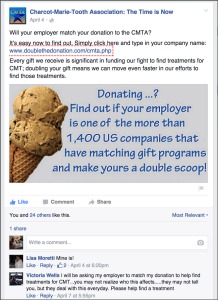 With so many people posting updates, Tweeting the latest news, and hashtagging photos of their lunch, it’s a good idea to jump on the social media bandwagon and utilize different sites to promote matching gifts programs.