 This month DonorDreams is hosting the nationally acclaimed Nonprofit Blog Carnival, and this month’s theme is: “If you could go back in time and give your younger-fundraising-self one piece of advice, what would it be?” As I’ve done each of the last three year’s when I’ve hosted the carnival, I plan on focusing this month’s DonorDreams blog posts on the topic as a way to help inspire other non-profit bloggers to submit posts for consideration. The April 2016 Nonprofit Blog Carnival is scheduled to go live on Thursday, April 28, 2016. So, mark your calendars because you won’t want to miss what other non-profit bloggers have to say on this topic.
Today’s time machine post involves a younger me who learned valuable lessons about how not to delegate and collaborate with others. Enjoy!
I am embarrassed to admit how many times I made the same mistake before finally learning how to effectively delegate and collaborate. In the following two sections, I will share examples where my younger-fundraising-self goofed up. In the final section, I will share with you what I’d tell my younger-self if I could go back in time with a few pieces of advice.
Annual campaign management
 As a young Boy Scout professional in the 1990s, I was just starting to learn may way around fundraising principles and best practices. While I previously had helped out with a few special events and written a grant proposal for another organization, I never helped plan-organize-implement an annual campaign pledge drive, which is what I was being asked to do with a group of Friends of Scouting (FOS) volunteer within my district.
With the help of the council’s Finance Director, I easily plowed through the early deadlines in my backdating plan. I nailed the pre-campaign tasks such as volunteer recruitment, setting FOS unit presentation dates, identifying community donor prospects, running pledge cards, goal setting, etc. I remember thinking early on how easy it all seemed.
And then the official “kickoff meeting” happened . . .
All of my volunteers gathered before work for an early morning meeting I sold as the “FOS Kickoff”. For slightly more than an hour over coffee and donuts, I walked my team of fundraising volunteers through training, review of materials, and even prospect assignment exercises. Everyone walked away from that meeting knowing the who, what, where, when and why.
Or so I thought.
Four weeks after the kickoff, nothing was happening. The signed pledge cards weren’t coming back to me with pledge amounts. Six weeks passed . . . still nothing was occurring and no one was returning my phone calls. Finally, I started panicking at the eight week mark because there was only one month remaining before the end of the campaign. It didn’t look like we’d come anywhere close to hitting our overall goal.
What I didn’t understand was that while I might have delegated all of those fundraising solicitations to volunteers, I still owned all of those tasks even though someone else had agreed to do them.
Grant reporting
 Fast forward a number of years into the future when I was a first-time executive director for a Boys & Girls Club.
After the resource development director, who I had inherited from the previous CEO, had resigned, I hired a replacement who had good pledge drive and event planning skills. Unfortunately, he lacked grant writing experience. I quickly concluded that I was the organization’s best writer, and I took over grant writing responsibilities.
As a former newspaper editor in a previous life, I knew how to write and took to grant writing like a baby duck takes to water. In short order, I fell into the routine of “research, cultivate, write” (aka rinse, later, repeat). And when we received funding, I turned everything over to one of my direct reports who was responsible for operations.
Whenever I handed over a grant, I always sat down with the operations director and reviewed the grant deliverables. I clearly explained what needed to be done (e.g. hiring, program planning, scheduling, kid recruiting, program promotion, outcomes measurement, etc). I also shared reporting deadlines from the funding partner.
As with the aforementioned annual campaign story, I walked away from those meetings knowing the who, what, where, when and why were as clear as possible. Everyone knew what needed to happen and by when.
Or so I thought.
I’ll never forget the first time a funder called me asking where our close-out report was and why we had missed the last few quarterly deadlines.
Even though it had been a few years between the lesson I had learned with my annual campaign volunteers and the staff supervision story pertaining to grant management and reporting, I still had obviously not learned the simple truism that delegating action items doesn’t mean I’m allowed to wash my hands of them.
Where is that time machine when you really need it?
 Sometimes when I daydream, I see myself standing outside my house in the street with Dr. Emmitt Brown (aka Christopher Lloyd’s character in Back to the Future), waiting for the lighting storm so I can jump into that DeLorean Time Machine. I know exactly where in the past I would first point myself.
It would be either immediately before my first FOS annual campaign kickoff meeting. Or it would be right before one of the staff meetings when I handed off grant materials to the operations director. <sigh>
I also know exactly what I’d say to my younger-fundraising-self if I had the opportunity:
- Never remove deadlines from your calendar even though you might delegated reporting to others
- Use your Microsoft Outlook task list and set future reminders to yourself about checking-in with employees who were tasked with reporting
- Include campaign goal amounts + deadlines + meeting dates/times in the campaign volunteer description to help set expectations during the recruitment process in order to help volunteers determine whether or not they are able to do what you’re asking them to do
- Schedule in-person “report meetings” every few weeks throughout the annual campaign where volunteers are asked to share their progress (or lack thereof) with each other
- Email campaign reports illustrating how the overall campaign is performing as well as how individuals are doing compared to each other
<Sigh> If I only knew then what I know now. 😉
If you are a non-profit blogger who wants to participate in this month’s Nonprofit Blog Carnival and submit a post for consideration on this month’s carnival theme, click here to read the “call for submissions” post I published last week. It should answer all of your questions and clearly explain how to submit your entry. If not, then simply email me and I’ll be happy to help.
Here’s to your health!
Erik Anderson
Founder & President, The Healthy Non-Profit LLC
www.thehealthynonprofit.com
erik@thehealthynonprofit.com
http://twitter.com/#!/eanderson847
http://www.facebook.com/eanderson847
http://www.linkedin.com/in/erikanderson847
 Like most Americans, I took a little time for myself at the end of 2014. I spent some of it celebrating the holidays with my family. I spent a little more of it celebrating the nuptials of an old friend. I spent the remainder of it in Napa Valley ringing in the new year over a few nice bottles of wine. While recharging my batteries, I came across a USA Today article from John Waggoner titled “
 As a donor, I discovered long ago that if I want to make a large contribution to a non-profit organization it probably won’t happen by writing one large check. While some people on this planet have that capacity, my bank account balance isn’t fat enough to do something like Bill Gates or Warren Buffet. However, “large contribution” is a relative term, and I made my first meaningful, sacrificial gift at the age of 27 when I pledged $1,000 to a local Boy Scout council while earning $27,000 working for that same organization.
 The United Way figured this one out a long time ago, didn’t they?
 Since the Great Recession of 2008, many non-profit organizations have explored and developed monthly giving programs. This strategy has been very popular with European charities, and it is akin to the “set it and forget it” mentality of our society.
 As many of you know, I am a big fan of
  I was having breakfast this week with a friend and fellow consultant and we were discussing resource development efforts, including events and grants. By now I’m sure you are well aware, I’m not a huge fan of organizations hosting multiple events. Events are expensive, labor intensive and don’t usually generate a lot of income.
 Grants, which are often 30% to 50% of an agency’s budget, more if they receive United Way funding, are one way. Yet, they too come with a cost. Most agencies get somewhere between 50% to 80% of the grants they submit. That means that the time spent on writing the 20% to 50% of the grants that don’t get funded is time lost. For the grants that are secured, there are reports to be written, dollars to be tracked, objectives to reach and programming to introduce. All of which is as it should be, and none of which is without cost.
 Sometimes I see things at just the right time and in the right place, and it results in me seeing something differently. Usually, when this happens it results in an AH-HA moment. This is exactly what happened to me yesterday when I opened an email from my friends at
  So, the title of today’s blog post had the word “AH-HA” in it, which implies that my friends at Non-Profit Humour inspired a light bulb of some sort.
 Yes, yes, yes . . . I know what you’re thinking: “Our agency doesn’t have things like hotel rooms, flights and cups of coffee to give away like these for-profit corporations.” But are you sure about that? Because I’ve attended many charity auctions in my life.
 Last week I was out with a friend for a glass of wine after work. We hadn’t seen each other in a few months, and we were catching up on lost time. “How are you? How is the new job? How’s your wife? Kids? Grandkids?” You know the drill. It was during this exchange that he dropped the bomb: “So, how is your partner? Ya know … the only time I ever see him is when he is asking me for a donation.”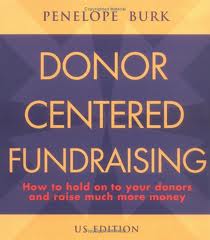
 These personal touches do not have to be all about your non-profit organization. I suggest that you train your volunteers to be less obvious. For example, both stewardship touches could be as simple as three minutes worth of messaging in the middle of a lunch meeting or after-work cocktail. It should feel organic and nature. It shouldn’t feel forced or contrived.
 Jeff Bezos has been on my mind lately. Of course, he is the 49-year-old owner of Amazon.com, and this internet pioneer recently purchased one of the iconic old media newspapers — The Washington Post — for $250 million. It was no more than a few days after this announcement that I was talking to a non-profit board volunteer about fundraising when I was reminded of this famous Jeff Bazos quotation: “A company shouldn’t get addicted to being shiny, because shiny doesn’t last.”
 I am a huge proponent of using technology and integrating it into your non-profit organization’s fundraising program, but it shouldn’t be introduced in a way that undercuts the other best practices embedded in your resource development plan.
 Welcome to O.D. Fridays at DonorDreams blog. Every Friday for the foreseeable future we will be looking at posts from John Greco’s blog called “
 Do you see it? Culture eats strategy!
 Hmmmm … looking back at that meeting, I think he was cooking up a hearty breakfast for me.
 The concept of “spray and pray” in resource development is simply sending out many appeals (aka shotgun effect), and then waiting for (aka hoping and praying) that enough donors respond so that you can make your goal. “Spray and pray” doesn’t just refer to direct mail. Back in the day, I used it in annual campaigns where I asked fundraising volunteers to identify five people from their social network, sit down with them in-person, and ask for a pledge or contribution. If your fundraising program is still loaded with “spray and pray” strategies, then you’re probably struggling because those days are long since over.
 think millions of other donors) would be: