
 As someone with two degrees in planning, I catch myself all the time with my non-profit clients explaining that the solution to their problems is that they need a plan. It might be a strategic plan, resource development plan, or board development plan . . . but oftentimes I am amazed at how many times failing non-profit agencies just haven’t invested in creating plans. I mean, come on folks! Who hasn’t heard the old expression, “If you fail to plan, then you plan to fail“?
In recent years, my point of view around planning has evolved slightly. I now believe there is a time and place for planning. When there is too much chaos in the external environment or too much internal crisis or turnover, planning is at best a wasteful exercise and at worst can contribute to the problems at hand.
Of course, I still bristle when I hear board members say something like:
“I don’t want my agency engaged in planning. In the end, all that happens is the plan gets put on the shelf to collect dust. We need less planning and more doing!”
When I hear statements like this, it is usually indicative of:
- an agency without a culture of planning
- staff without an understanding of how to engage a board
- board volunteers without an understanding of implementation tools
- a board who doesn’t manage or evaluate its staff
- an agency that is either standing still (best case scenario) or in crisis (worst cast scenario)
When trying to make the case for engaging in some sort of planning activity to a board of directors, I typically talk about “roles and responsibilities” of the board of directors. As you might imagine, this approach is usually met with yawns and eye rolling.
However, I recently found a blog post by Nell Edgington titled “5 Ways Great Strategy Can Transform a Nonprofit” while clicking around on a LinkedIn group dedicated to strategic planning for non-profit organizations. It was in that post I think Nell makes a much better case for planning that might be better received by resistant boards.
Here is what she says:
“People and organizations that make large gifts to a nonprofit are in effect investing in the future of that organization. And if you can’t articulate your future plans in a thoughtful, compelling way, funders won’t make that larger investment.”
Duh!
So, what has been your sales pitch to your board when trying to convince them to roll up their sleeves and engage in some planning. Please share your thoughts and experiences in the comment box below. We can all learn from each other.
Here’s to your health!
Erik Anderson
Founder & President, The Healthy Non-Profit LLC
www.thehealthynonprofit.com
erik@thehealthynonprofit.com
http://twitter.com/#!/eanderson847
http://www.facebook.com/eanderson847
http://www.linkedin.com/in/erikanderson847
 On Tuesday evening I found myself sitting in front of a group of board volunteers as well as prospects who were contemplating joining the board. What started off as a routine training about basic board roles and responsibilities morphed into a discussion about what makes an exceptional board.
 If I’ve heard it once, I’ve heard it hundreds of times . . . non-profit board volunteers and staff hate strategic planning. Why? The reasons are all over the place, but some of the more popular reasons given are:
 As they say, the proof is in the pudding which is what inspired today’s blog post. The pudding, of course, is an article that washed into my email inbox from LinkedIn on November 30, 2013. The author was John Wasik and the article was titled “
 Sometimes I hear something that hits me just right, and it takes days to get it out of my head. This happened on Tuesday during the Fox West Philanthropic Network’s
  Dani suggested that board volunteers who are “strategic thinkers” will have an easier time making the transition from traditional fiduciary modes of governance to more strategic and generative modes.
 If you’re scratching your head while reading this list and asking “what does THAT mean,” then click the link and read the CEB Blog post. It really is quite good. If you want to learn more, then I suggest you start Googling around. 😉 You also might want to
  I love Monday mornings! I wake up, feed the dog and cat, grab a cup of coffee, sit down at my computer and open my email, and most Monday mornings involves watching “
 Welcome to the final post in our five-part series on Governance. We have already discussed the Board’s role in
 I was reviewing some old non-profit board governance material this morning and came across a document talking about “trends in non-profit governance“. In other words, the person who wrote that paper thought s/he was able to predict the future. Of course, this document was written more than 10 years ago, which got me thinking it might be fun to review some of their trends and determine where they were right or wrong.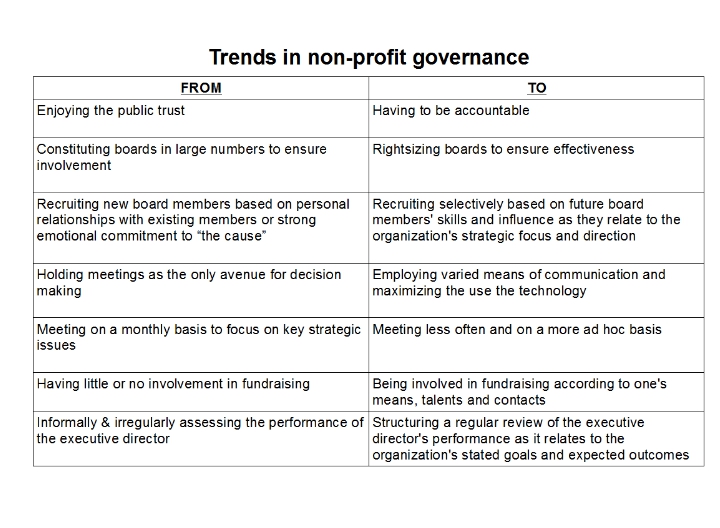
 Last week a dear non-profit friend of mine from California couldn’t sleep. She tossed and she turned. Ultimately, she got out of bed, turned on her computer and started talking into a microphone. When I woke up in the morning in my bed in Elgin, Illinois, there was an email sitting in my inbox with a voice file attachment. Her words have tumbled around in my head for a week, and I’ve decided to enlist your support in dissecting them.
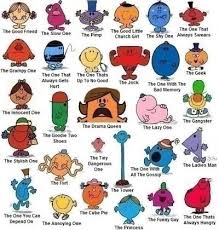 After listening to my friend’s recording, I started Googling around and searching for anything that anyone might have written about characteristics and traits of effective boards. I was especially intrigued by her question about incorporating personality testing into the board development process. After all, many workplaces are incorporating this type of assessment into their employee hiring process.
 Competencies
 More than a year ago, I stumbled upon a fun article published in the Stanford Social Innovation Review (SSIR) titled “
 So, the conversations I’ve been referencing throughout this post have to do with board development and not the actual revenue models.