Do you understand your resource development roles and responsibilities?

Yesterday’s post was titled “Can you pass the board roles and responsibilities test?” and questioned how non-profit organizations can and should strive to keep board members focused on their appropriate roles. Included in yesterday’s post were a few fun test questions designed to help you to realize that answers to these questions aren’t always obvious, which is why thoughtful strategies must be developed and used to maintain clarity.

Before we move on to a new set of questions regarding board volunteers and their roles/responsibilities around resource development, we still have some unfinished business to transact from yesterday’s blog post. The following are answers to yesterday’s poll questions along with brief explanations :

  • Question #1: “The executive search committee hires the executive director?” While 44% of respondents said this was a true statement, the reality is that only the board of directors as a whole can hire the executive director. Yes, the search committee does much of the work and makes the recommendation to the board. However, technically speaking it is just a recommendation that doesn’t turn into an actual hire until the entire board votes to make it so.
  • Question #2: “It is a primary responsibility of the board to develop and monitor adherence to personnel policies?” Respondents were split evenly on this question with 50% saying it is a true statement and the other half saying it is false.  This was a trick question and depending on how you read it, you are probably right. In reality, developing and monitoring adherence to personnel policies is a primary responsibility of BOTH board and staff.  Remember, the board also has an employee to manage (e.g. executive director) and as such they are “monitoring adherence” as much as the executive director is doing so with the remainder of the agency’s staff. As for policy development, it is true that staff play a major role, but in the final analysis setting policy can only be done by the board (albeit with staff input and assistance).
  • Question #3: “It is a primary responsibility of the board to review the organization’s policies, procedures, and bylaws?” While 88% of respondents said this was a true statement, the reality is that like the last question this is a primary responsibility of BOTH board and staff who work together to get this done. In the end, policy making is clearly a board role, but staff play a supportive role in the review process including making recommendations and weighing in with their professional opinion.

Let’s put aside whether or not you agree with these textbook answers. The bigger point I am trying to make is that questions around board-staff roles and responsibilities can get fuzzy for trained non-profit professionals (see results above). So, it shouldn’t be a surprise that board volunteers need their staff to help them maintain clarity and alignment.

Well, that was a lot of fun! Want to try it again? Please take a stab and answering some of the following questions around non-profit board-staff roles and responsibilities specifically focused on fundraising and resource development (don’t worry, no one can see how you individually answer):

[polldaddy poll=6654135]
[polldaddy poll=6654141]
[polldaddy poll=6654146]

I will share the answers with you tomorrow, which means there will be two blog posts tomorrow with one focused on our traditional “organizational development” Friday topic and a second containing answers and explanations to today’s resource development poll questions. WOW . . .that is a “two-fer” on a Friday! What more can you ask for?  😉

How do you keep your non-profit board from becoming “unaligned” when it comes to clarity around board-staff roles & responsibilities in the area of fundraising? Do you use certain tools (e.g. an annual board re-commitment pledge, etc)? Can you share those ideas and tools with your fellow readers? Are there particular strategies that you use (e.g. resource development planning process, etc)?

Please scroll down to the comment section and share your thoughts, tools, and approaches with your fellow non-profit professionals. We can all learn from each other.

Here’s to your health!

Erik Anderson
Founder & President, The Healthy Non-Profit LLC
www.thehealthynonprofit.com 
erik@thehealthynonprofit.com
http://twitter.com/#!/eanderson847
http://www.facebook.com/eanderson847
http://www.linkedin.com/in/erikanderson847
Do I know you? And why are you asking me to join your group?

I am constantly amazed at how careless some non-profit organizations are with their volunteer recruitment  efforts. Correct me if I am wrong, but building the right board, advisory group, or fundraising committee with the right people is at or near the top of every smart nonprofit professional’s task list. Right? Well, if this true, then can someone explain to me why I’m getting random emails and Linkedin requests from people I don’t know asking me to join something?

The following are a few excerpts from one recent email (names have been changed to protect the innocent):

“We are now accepting applications for the Associates Board.  The Associates Board will provide young professionals with the opportunity to get involved in event planning, fundraising, social media, and recruiting . . .

To apply, please review the commitment, roles, and responsibilities, and our application procedures by clicking here.

If you have any questions, please feel free to contact XXX XXXXXXXXX, our Associates Board President, at XXX@XXXXXXXXX.org.

Please feel free to forward this email onto any young professional who you think may be interested!”

There are so many things that concern me about an email like this. Here are just a few:

  • They don’t know me. They don’t know my skill sets. They don’t know if I would be a great fit for this volunteer opportunity.
  • They don’t have the time to review important things like roles and responsibilities with me? They made this a self guided activity.
  • So, they want me to think that I’m important enough to join their Associates Board, but I’m not important enough to call?
  • They’re giving me permission to forward their invitation to anyone? I now fear who else could be sitting around this table talking about issues such as “event planning, fundraising, social media, and recruiting”.

Here is another random request I received from someone I don’t know via LinkedIn (again, I changed the names to protect the innocent):

“Hey Erik,

Would like to have you as a member of the XXXXX National Fundraising Advisory Committee, what day and time can we discuss? Please check out our website at www.abcdefg.net for more information, I look forward to speaking with you!”

I must admit that I’ve sent out “messages in a bottle” like this, but I have never been so presumptuous as to ask someone I don’t know to do anything other than please take a phone call from me.

Have you ever had the pleasure of sitting on a board or committee with a group of very caring people who don’t have a clue as to how to do what they are being asked to do? If you have been spared this experience, I sincerely hope you never get the opportunity because it is frustrating.

I believe that non-profit professionals need to construct volunteer groups (e.g. boards, committees, etc) in much they same way they hire staff.

  • Put some thought in what skills the people around the table will need to accomplish what you’re asking of them.
  • Approach people who you believe possess such skills.
  • Be clear about expectations upfront in order to avoid misunderstandings. Share written volunteer job descriptions, roles & responsibilities documents, and written plans with volunteers before asking them to join.

Recruiting random people to do work for your organization is irresponsible. It can set people up for failure. It can also create horrible group dynamics and poor results.

If this blog post is not resonating with you, then let’s agree to do this. I will go to a very public place and ask for random volunteers to attend your annual campaign kickoff meeting with me. You will entrust us with pledge cards and some personal information about your donors. Let’s see how well this works out for you and your campaign, and we can talk about it at your post-campaign critique meeting.

We’ve all made mistakes in recruiting volunteers, and we can all learn from each other’s mistakes. Without embarrassing yourself or anyone else, please use the comment box to share a few lessons learned and explain what you’re now doing differently.

Here’s to your health!

Erik Anderson
Founder & President, The Healthy Non-Profit LLC
www.thehealthynonprofit.com 
erik@thehealthynonprofit.com
http://twitter.com/#!/eanderson847
http://www.facebook.com/eanderson847
http://www.linkedin.com/in/erikanderson847

Will the lawyer on your non-profit board really provide legal advice?

An executive director friend and I went to lunch a few weeks ago to catch-up on life and share stories. The company was great, the lunch was good, and I learned something new about non-profit board volunteers who work in the legal community. As it turns out, some law firms seem to be requiring their employees to clear a number of hurdles before serving on a non-profit board.

This revelation came about when my executive director friend said something to the effect of: “. . . and now the lawyer on my board can’t even provide legal advice in the boardroom.”

As you can imagine, I heard that old record player needle scratching across the surface of a vinyl album (ugh . . . yes, I am dating myself and obviously don’t belong to the Millennial generation). I swear the restaurant went dead just like in those E.F. Hutton television commercials, and all I could utter was one simple word . . . “Huh?”

So, my friend went on to explain that a new board volunteer, who just happens to be an attorney, sent him a letter from his law firm requiring the executive director to sign-off on a letter of agreement outlining the conditions of their employee’s board service.

I had a difficult time wrapping my head around this concept and asked my friend to email me a copy of the letter. The following are excerpts from that letter (with the names excluded to protect the innocent):

“The Firm has adopted policies regarding circumstances under which a Firm lawyer may serve as a director for non-client companies, and prohibits such service without permission of the Firm’s Professional Responsibility Committee. An additional prerequisite to my service is that I obtain written acknowledgement from the non-profit organization (The Company) regarding the capacity in which I will be serving on the board, and certain other matters. By signing and returning this letter to me, therefore, the Company and the Board acknowledge the matters stated below:

  1. I will be serving in my personal and individual capacity only. I will not be acting as a lawyer or providing legal services or advice to the Company. I will not be acting as an agent, partner or employee of the Firm.
  2. The Company acknowledges that it is not now a client of the Firm, and understands that the Firm will not be able to represent the Company without first obtaining special permission from the Firm’s Professional Responsibility Committee, which permission is rarely granted or unless I resign as a director.
  3. Because I will not be providing legal services or advice in my role as a director, there will be no attorney-client privilege protecting communications between me and the Company or the Board.
  4. As mentioned, the Firm’s policy prohibits director service by Firm lawyers without Professional Responsibility Committee permission. The Firm’s policy also requires that the Professional Responsibility Committee reconsider this question at least annually. Although the committee has indicated that it will permit me to serve as a director of the Company, it is possible that the Committee could change its view on this question in the future. If this were to occur, I would have to resign as a director at that time.”

I must admit that I’ve read this letter over and over again in disbelief.  A number of things raced through my mind each time I read it, including:

  • Why would I ever recruit someone from a law firm who I might one day want to retain for legal counsel?
  • Board volunteers are suppose to bring their “Time-Talent-Treasure” to their non-profit board service. If I can only get two of three, is it still worth recruiting an attorney to serve on the board? Or would they just make a better special event or annual campaign volunteer?
  • Why would I ever include an attorney on my board as part of a board officer succession plan when the Firm can yank them off my board in a moment’s notice?

I am sure that if I thought about all of this for another few minutes, I could come up with additional questions and concerns. But where is the fun in that when I can open it up for discussion with the awesome non-profit professionals and volunteers who subscribe to this blog?

What questions and concerns do you have when you read excerpts from this letter? Have you been asked to sign off on anything similar by an attorney serving on your non-profit board? Does this letter of agreement impact how you think about recruiting an attorney to serve on your board? Why? Why not?

Please use the comment box below to share your thoughts on this important board development subject. We can all learn from each other.

Here’s to your health!

Erik Anderson
Founder & President, The Healthy Non-Profit LLC
www.thehealthynonprofit.com 
erik@thehealthynonprofit.com
http://twitter.com/#!/eanderson847
http://www.facebook.com/eanderson847
http://www.linkedin.com/in/erikanderson847

Birds of a feather meets angry non-profit birds

Yesterday, my post was more of a question than anything else. I hoped you would join me in wondering if most board development processes really just result in boards replicating themselves. For example, a board full of middle management white-collar employees will beget more of the same. I ended the post with more questions focused on the idea of board transformation and asked if anyone has ever seen this done effectively.

After writing yesterday’s post, I jumped in my car and started a multi-day business trip. At my first stop, I had the pleasure of being able to continue this discussion about: bird of a feather flock together, boards replicating themselves, board transformation, and other board development approaches.

It was a robust discussion, and it reminded me of why I love non-profit work. Here are just a few things that popped out of that discussion yesterday:

  • there is no doubt that boards replicate themselves,
  • birds of a feather do indeed flock together, and
  • board transformation (whatever that may look like) needs to be managed very carefully to avoid hurt feelings and damaged donor relationships.

All of this got me thinking about situations where I’ve worked with a blended board of directors. What I mean by “blended board” is a group of volunteers who come from significantly different social circles, groups, sectors, etc.

It exists . . . in fact many non-profits are actually pursuing this idea all in the name of “board diversity.”

I am specifically thinking of one organization who I’ve worked with, and their board room contains:

  • a few CEOs and big business people,
  • one or two blue-collar construction folks,
  • a few country club wives,
  • a handful of middle managers, and
  • a former client.

So, you’re probably still wondering what inspired the title of this morning’s post. Simply stated, the “birds of a feather” refers to yesterday’s post, and the “angry birds” reference is a cautionary tale for non-profits who are aggressively pursuing the idea of blended boards and diversity.

When you have a blended boardroom, there are two big things that I think executive directors need to be on the look-out for:

Avoid board segmentation

I’ve seen blended boards where the “business people” and “folks with tons of influence” take on certain responsibilities (e.g. fundraising) and let others off the hook.

Here is what I’ve seen when blended boards segment themselves into “those who can” and “those who can’t”:

  • resentment
  • exhaustion
  • confusion
  • condescension

Every road leads to a bad place, and I’ve never seen it end well.

Avoid volunteer alienation

I’ve seen blended boards who work very hard at maintaining uniformity in expectations, roles, and responsibilities. So, the “CEO-type of board member” is held to the same standard as the “stay at home mom on the board”.

While this might sound “fair” to some of you, I assure you that this road is equally ugly. Here is what I’ve seen in these situations:

  • feelings of inadequacy
  • feelings of incompetence
  • finger-pointing
  • excuse making
  • under-performance

What I’m trying to say this morning is that if you are one of those non-profit professionals who actively fights against the “birds of a feather flock together” phenomenon, then you need to also be on the lookout for “angry non-profit birds” syndrome.

Here are just a few quick thoughts in my head for my non-profit executive directors friends out there:

  • Make sure your board recruitment process is followed. You are the guardian of process at your organization. Resist board members requests that sound like: “Awww, let’s just ask Betty to join the board. You know she’s perfect. Let’s just cut a few corners in the process.”
  • Make sure that your board development process educates prospective board volunteers on roles, responsibilities, and expectations BEFORE asking them to join anything.
  • Make sure your board development process includes regular doses of “education and training”. Using small training modules in the board room and infusing training into annual campaign kickoff meetings and board retreats ensures your board volunteers are growing.
  • Manage relationships. When you see board volunteers struggling, don’t look the other way. You can either personally engage and provide coaching to a struggling board volunteer or you can employ other board volunteers to provide that coaching. The end result might look different in every situation with some volunteers growing into their board roles and others finding other more comfortable seats on the bus that don’t involve serving on the board.
  • Don’t set people up for failure. If someone is a bad fit for the board, don’t ask them to join just because they have a large checkbook.  There is no shame in asking someone to sit that is a better fit for their talents and passions.

Do you have a blended board with lots of diversity? How do you manage it? How have you kept it from splintering into “us” and “them”? How have you kept individual volunteers from feeling out-of-place or like they aren’t pulling their weight? Please scroll down and share your thoughts and experiences in the comment section. We can all learn from each other.

Here’s to your health!

Erik Anderson
Founder & President, The Healthy Non-Profit LLC
www.thehealthynonprofit.com 
erik@thehealthynonprofit.com
http://twitter.com/#!/eanderson847
http://www.facebook.com/eanderson847
http://www.linkedin.com/in/erikanderson847
Do non-profit board volunteers of a feather really flock together?

My mind has been stuck in a board development rut lately, and I can’t stop thinking about whether it is possible for a weak board to get itself out of the ditch. Author Jim Collins in his book “Good to Great” talks about the importance of getting the right people on the bus and in the right seats. Cross apply Collins best practice with that old expression “Birds of a feather, flock together” and that is where I get stuck.

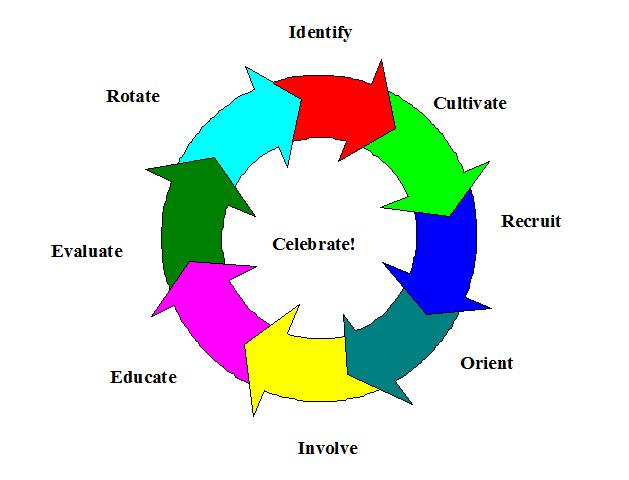
So, the picture to the right of you screen represents a very traditional board development process for the average non-profit organization. I found this particular board development cycle in old materials from my last job, and is was apparently adapted from “The Board Building Cycle: Nine Steps to Finding, Recruiting, and Engaging Nonprofit Board Members”, Second Edition by Berit M. Lakey (BoardSource, 2007).

Have you ever sat in a non-profit board room, looked around the table, and saw a bunch of people with big hearts, small checkbooks, and very little influence?

How many times have you seen a group of people fitting that description try to transform their boardroom? I have seen it too often, and in each instance they toss out the names of the “Whose Who” in your community. Yet, at the end of the board development process, none of those names seem to be occupying seats around the table.

Every time I start to focus on this phenomenon, the expression “Birds of a feather, flock together” comes to mind.

Sure, sometimes I see “Average Joe” and “Average CEO” sitting around a boardroom table talking about governance, fundraising, mission, and all things non-profit. However, it is the exception and definitely not the rule.

This all leads me back to where I started this post. Is there a different process that non-profits should use to transform their board of directors into a group of highly influential people?

I’ve recently been speaking with an old friend who emphatically says “YES” to this question.

His process is external to the board. It involves recruiting one board recruitment champion who: 1) is not a board member and 2) has so much influence that it is virtually impossible to say “NO” when s/he comes knocking on your door. There is more to his process, but in the final analysis the boardroom is transformed with most of the old board members finding different seats on the bus and the new board volunteers being highly influential, effective and engaged.

Has anyone out there every seen a non-profit board transform itself? What did that process look like? How did it unfold? What role (if any) did the existing board play? Please use the comment box below to share your observations because we can all learn from each other.

Here’s to your health!

Erik Anderson
Founder & President, The Healthy Non-Profit LLC
www.thehealthynonprofit.com 
erik@thehealthynonprofit.com
http://twitter.com/#!/eanderson847
http://www.facebook.com/eanderson847
http://www.linkedin.com/in/erikanderson847

Non-profit board volunteers should all dress the same

Welcome to O.D. Fridays at DonorDreams blog. Every Friday for the foreseeable future we will be looking more closely at a recent post from John Greco’s blog called “johnponders ~ about life at work, mostly” and applying his organizational development messages to the non-profit community.

Today, I am focusing on a post that John wrote about “Decision Fatigue,” which is a fascinating organizational development concept that applies perfectly to so many different aspects of non-profit work life. I mean come on, John! It would be soooooo tempting to expand on the “Kissing while driving for non-profit agencies” post from March 9, 2012 and talk about the utter insanity behind most executive director’s day-to-day routines. But I won’t do that and instead decided to focus on the board of directors.

After reading John’s post this morning, I was transported back in time to March 20, 2000. I will never forget that day because it was my first day on the job as a newly minted executive director.

At the top of every new CEO’s “To Do List” is a whirlwind tour of meeting board members. This is one of the most important first tasks because you are trying to get a feel for:

  • what is going on throughout the organization
  • what personalities are sitting around the boardroom table
  • how decisions get made in the board room

When I stuck the thermometer in the turkey on March 20, 2000, it immediately registered “DECISION FATIGUE“.

This board had operated for more than six months without an executive director. Some of the people during our first meeting even told me of their plans to resign. Needless to say, within the first 90 days the board roster shrank from 20 people strong to 11 very weary individuals who bravely faced the future and simply said, “FORWARD!

The list of decisions that fatigued the board prior to hiring an executive director is endless, but here are just a few of those decisions they routinely faced:

  • Where are we meeting? What time?
  • What’s on the agenda?
  • Who is attending? Do we have quorum?
  • What materials should be distributed prior to the meeting? Who puts all of that together?
  • How do we make sure everyone is properly prepared for tough discussions and decisions at the upcoming meeting?
  • Do we have enough money in the bank to make payroll next week?
  • Which employee just quit? At which site did they work? What does that mean for operations? Is there paperwork that needs to get filled out? Who is doing THAT?
  • Who is doing what and with whom with regards to the annual campaign pledge drive that is scheduled to start next week?
  • Uh oh . . . I though we were just focusing on the pledge drive, but now we’re talking about special event planning for the dinner that is 12 weeks away. Who is doing what and with who regards to all of THAT?
  • Ummm . . . how does all of this mesh with the decisions happening at home and at my paying job?

This is just a small sampling of what was on those board member’s decision-making list.

One of the most interesting things I found in my first 90 days was the board decision made right before they hired me. It was the decision to stop meeting monthly and only meet every other month. When I asked why they made this decision, they said that their monthly meetings had gotten way out of hand and too long. Those meetings apparently lasted sometimes three or four hours!

Like you, I scratched my head, and asked how in the world that decision made any sense.

If you think about it for a moment and put yourself in their shoes, it makes perfect sense:

  • They were tired.
  • They needed more time between meetings to re-group.
  • This allowed them to “empower” the executive committee to make decisions for the board during the off-months (e.g. dump the tough work on a smaller group of people).

I don’t need to tell you how damaging that decision was to the agency’s health, but it made sense when you look at it through a “decision fatigue” filter. It took me almost three years to get them to reverse their decision and start meeting every month again.

It is the job of the executive director to help the board avoid “decision fatigue”.

Good non-profit executive directors support the work of their board by facilitating and assisting with everything including:

  • developing agendas
  • taking meeting notes
  • recruiting new board volunteers
  • supporting committee work
  • helping board volunteers process tough issues and position them for making tough decisions in the boardroom
  • supporting all of the planning work that occurs ranging from strategic planning to special events
  • And much, much more!

So, I titled this blog post the way I did because of the Vanity Fair article that John cited in his blog post. In that Vanity Fair interview with President Obama, they explain why the President is almost always seen in blue or grey suits. Of course, it has everything to do with decision fatigue, and this got me giggling about non-profit board volunteers as I envisioned a boardroom full of volunteers wearing the exact same thing.

Hmmmm . . . perhaps board tee-shirts might not be a bad idea.  😉

Is your board tired? Have you given any thought to why? What role have you played in their fatigue? What could you be doing differently? Here’s a thought . . . if this is something with which you’re struggling, use the comment box below to ask a few questions of your fellow non-profit peers and see what they have to say. Or if you have a great success story, please feel free to share that as well.

Here’s to your health!

Erik Anderson
Founder & President, The Healthy Non-Profit LLC
www.thehealthynonprofit.com 
erik@thehealthynonprofit.com
http://twitter.com/#!/eanderson847
http://www.facebook.com/eanderson847
http://www.linkedin.com/in/erikanderson847

Non-profit board work that moves the needle

Dani Robbins is the Founder & Principal Strategist at Non Profit Evolution located in Columbus, Ohio. I’ve invited my good friend and fellow non-profit consultant to the first Wednesday of each month about board development related topics. Dani also recently co-authored a book titled “Innovative Leadership Workbook for Nonprofit Executives” that you can find on Amazon.com. 

I’ve given a lot of thought lately to how the work of the Board gets done. Mostly, it’s by decisions made in meetings and in-between meetings. Board members go to a lot of meetings, committee meetings, board meetings, and meetings with the executive director. Additionally, there’s work to do between meetings,  and it all leaves me wondering:  Where’s the strategy? Where’s the generative thinking? Where’s the advocacy? Where’s the impact? How do we know?

Boards approve things, they review things, they talk about things, but . . .

Are they the right things?

Boards have to have a quorum.  approve financials and meeting minutes, and a whole host of other things. Hopefully, Board members also represent the agency in the community, understand and talk about programs, support and evaluate the executive director, raise money, and give money. These are their fiduciary responsibilities. But surely, this isn’t all we have our Board members doing. They are the pillars of our community. They are smart, professional and talented people, but . . .

Are we correctly utilizing their collective brain power?

Have they decided upon a strategic direction? Have they discussed the underlying causes that created the issue the organization originally was created to address? I am hearing a resounding chorus of NO!

All too often, there is no plan, strategic or even tactical. There are no metrics. There is no discussion of root causes, alternative options or new ideas. There are talented people sitting in a room because they care about the mission of the agency –- and in certain, but by no means all cases — we are wasting their time. And as such we are wasting our resources.

Strategic planning has fallen out of favor. It kills me to say it, but it’s true. Most Board members have sat through at least one planning session, often more, that were long and boring; yet they sat there in an effort to decide the mission and direction of an agency. And as a prize for their dedication, they got to spend two hours debating if they were going to use the word “a” or “the” in the mission statement. Then, when they were – thankfully – finished after days or months and considerable expense, the plan sat on a shelf, collecting dust, never to be seen again.

It doesn’t have to be like that.

In the article, “Governance as Leadership; An Interview with Richard Chait,” Chait discusses his book “Governance as Leadership” (BoardSource) which “recommends reframing board work around “three modes” of governing. The first is the fiduciary mode, in which the board exercises its legal responsibilities of oversight and stewardship. The second is the strategic mode, in which the board makes major decisions about resources, programs and services. The third is the “generative” mode, in which the board engages in deeper inquiry, exploring root causes, values, optional courses and new ideas.”

You may be wondering how to add generative and strategic to your meetings.

Strategy” is all about connecting the resources to the goals, which, of course, requires having strategic goals.  If you don’t, I encourage you to read my previous blog about wheel spinning and begin to discuss planning.

Generative” is a much deeper conversation about the underlying issues and how to impact them.  Chait presents governance discussions as ones that “select and frame the problem.”   In other words, we’re no longer talking about impact or program outcomes or even the agency itself, we’re talking about how we  — our city, community, country or even world –- got here and what it takes to get out of here.

Chait explains it best when he says,

“Committees need to think not about decisions or reports as their work product, but to think of understanding, insight and illumination as their work products.”

In order to use the collective brain power of our Boards to move our agencies forward, we have to move into strategic and generative governance, while still meeting our fiduciary obligations. The board president and the executive director can, should, and I would submit, have the obligation to use the collective brain power of their board to move the needle. It’s why we’re here. In the absence of that, we approve things, we attend meetings and we go through the motions, but nothing happens.

I want something to happen . . . I want the world to change.

What’s been your experience? How have you utilized the talent on your Board to move the needle? I welcome your comments.

I’m a non-profit board volunteer

Dani Robbins is the Founder & Principal Strategist at Non Profit Evolution located in Columbus, Ohio. I’ve invited my good friend and fellow nonprofit consultant to blog this week about board development related topics. She also agreed to join the DonorDreams team and contribute a board development post every month. Dani also recently co-authored a book titled “Innovative Leadership Workbook for Nonprofit Executives” that you can find on Amazon.com. I hope you enjoy the genius musings of my friend for the next few days . . .

I’m presenting a workshop this summer called the “10 Dysfunctions of a Board”.  As you might imagine, one of the top ten is what I have begun to think of as the “I’m a Volunteer” syndrome.

Perhaps you’ve had some version of this conversation with a member of your board.  It sounds like this:

“Dani, I don’t have time for this; I’m a volunteer!” 

And they are, but they are also a board member who agreed to do the work of the board.  Now, agree may be a fuzzy verb to use because it’s possible they didn’t agree at all.  It’s possible, all they were told is:

“We only need an hour a month of your time.” 

If that’s the case (and it often is) shame on whoever told them that.  Boards represent the community as the stewards of an organization.  It is very difficult to steward anything well in one hour a month.

You will get the Board you build.

Now, this blog is not intended to knock the millions of dedicated and committed volunteers across this city and the county that serve their local non-profits with distinction. I applaud you, and I am grateful for your commitment! Thank you for your service to our community!

This blog post is not intended to knock anyone.  I aspire to lay out a path of development, so that organizations can have the right people in leadership seats.

How do you do that?  The best way I know to do that is to front-load it.  Front-load is my 2012 word of the year.  It means to be clear about things up front, so there is no confusion.

Front-loading board prospect appointments look like this:

  • “Thank you for your interest in serving on the Board of Directors.
  • We are delighted to have this opportunity to meet with you.
  • Our Board meets on the 1st Tuesday of the month at 8:30 am.  Are you available at that time?
  • We anticipate Board service will take approximately 5 hours per month, (1.5 hours at the board meeting, 1.5 hours at a committee meeting, 2 hours working with the committee or the CEO to accomplish the work for the committee), but that could go up significantly should there be something of consequence to discuss or address.
  • Board members are expected to attend 75% of Board meetings, serve on at least one committee, attend agency events, act as an ambassador in the community, introduce us to your circle of influence, give a “significant to you” financial gift, and help us to secure an additional gifts from your circle of influence and, as appropriate, your company.
  • Is this something to which you can commit?”

If they say yes, Great!  Though we’re still not finished.

Their candidacy still needs to be vetted by the Board Development committee. If they are recommended, nominated and approved, then they also need to be oriented.  I like to orient board members after their election yet before their first meeting.  That way, they can still opt out once they understand the full scope of the expectations and the role of the Board.

After their orientation, individual board volunteers, and the boards upon which they serve, should be evaluated annually. This can be as simple as taking your board expectations document and turning it into a 1-5 self rating form. It can also be as complicated as tracking all gifts, training, participation and meeting attendance and asking the Board Development or Executive Committee to evaluate each member individually.

The important thing is that you are intentional about your needs and clear about your expectations.  If you are, then people will rise to the occasion, or they will defer because they can’t.   Both will work toward your goals of building a strong board of directors that understands their role and works collectively to serve the agency and the community.

As always, I welcome your comments, and your experience.

Becoming a non-profit board president

Dani Robbins is the Founder & Principal Strategist at Non Profit Evolution located in Columbus, Ohio. I’ve invited my good friend and fellow nonprofit consultant to blog this week about board development related topics. She also agreed to join the DonorDreams team and contribute a board development post every month. Dani also recently co-authored a book titled “Innovative Leadership Workbook for Nonprofit Executives” that you can find on Amazon.com. I hope you enjoy the genius musings of my friend for the next few days . . .

Congratulations for being named Board President!  You are going to be great!  I am so honored that you turned to me for some suggestions as to your responsibilities. Thank you.

In a nut shell, your job is to:

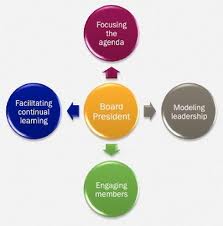
  • lead the board by inviting participation of board members;
  • guide evaluations of the organization, executive director and the board;
  • facilitate communication among the board and between board and staff;
  • delegate authority;
  • raise funds and support resource development efforts; and,
  • maintain visibility in the community.

That is the big picture of the job. How that translates into actual work is this:

President/Chairs lead meetings by following the meeting agenda, making it critical to have an agenda. When you chair the meeting keep the conversation on point, if it veers off point, call the question, table any motion and/or send the issue back to committee for further discussion.  Do not let the board meeting became a committee meeting, but do encourage all interested parties to attend the next committee meeting to further discuss the issue. This will promote the engagement of those who are passionate about the issue, and continue the engagement of those who are not.

The Board President appoints committee chairs and holds them to account, ensures conflict of interest policies and other policies are upheld by Board members, and supervises and evaluates the Executive in concert with or on behalf of the Board. President’s chair meetings, but do not vote or make motions.  They only vote to break a tie. They do steer the conversation, share their opinions and keep the group on task.

The Board is responsible for governance, which includes mission, vision and strategic planning; hiring, supporting and evaluating the executive director; acting as the fiduciary responsible agent, setting policy and raising money.  Everything else is done in concert with the executive director or by the executive director.

When you become Chair sit down with the executive director and map out your goals for your term. Discuss how you and the Board will be evaluating him/her and by what measurement you will gauge his/her success.  Check in on when the last time the board reviewed the mission and vision of the agency. If it’s been a few years, consider a Board retreat to revisit, revise or recommit. Please also discuss how you like to be contacted and set a plan to meet twice a month to discuss relevant issues, problems, and successes as well as progress toward your goals and/or the strategic plan.  Be prepared to take calls in between should something come up – because something always comes up.

Board President’s have a lot of power. Use that power wisely. If you ask for something, the staff will drop whatever they are doing to get it for you.  I would hope that they will be comfortable enough with your leadership to explain the price of what they are dropping, but it is likely they won’t.  In fact, I recommend you don’t go to the staff at all and instead work through the executive director for whatever information you would like. If it is not feasible to go through the executive director, then please ask via email and cc the Exec. S/he cannot be held accountable for managing a staff that are getting directions from others, and the staff will become confused as to from whom they take direction and who’s direction takes priority.

On behalf of executive directors everywhere, I ask you to please remember that they are the CEO of the company, and not a department head. You are the Chair of the Board, which is responsible for governance.  S/he is the leader of the agency and responsible for everything else.

I encourage you to review Robert’s Rules of Order and follow the entire procedure for votes including asking: All in favor?  Any opposed? Any abstentions?  Don’t leave out the last two.  In addition to alienating whatever Board members wanted to go on record for opposing or abstaining, it will make future challenges more difficult to defend. The following need votes:

  • Any Policy – crisis communication and management, personnel, etc. (Procedures do not need votes. Think of it like the difference between the rule and the law.);
  • Past board meeting Minutes;
  • Financial reports;
  • Agency Annual Budgets;
  • Plans – strategic, board development and/or resource development;
  • Changes to the strategic direction of the organization;
  • The hiring of an Executive Director;
  • Campaigns;
  • Opening, closing or changing the signatures on bank accounts;
  • Changes to the mission or vision; and Board Members and Officers being added, or renewed.

Resignations can be noted in the minutes and do not require votes.

Please also review your agencies by-laws, also called the Code of Regulations. All valid votes require a quorum of Board members to be in the room (or on the phone if your by-laws allow) – usually ½ of the board, but your by-laws may require more, or possibly less.  You can start a meeting without a quorum, but cannot vote until a quorum has been reached.

Lastly, I encourage you to plan your year, structure board meetings to align with strategic goals, and to frequently remind board members of the mission of the agency.

I’ll be here if you need me.  You’re going to be great!

Advice for all non-profits: “It is time to talk human again!”

So, I was sitting in my living room watching television and trying to multitask last night when one of the commercials that I was trying to ignore jumped out of my television, grabbed me by my shirt collar and shook me hard. It was an advertisement by Skype and it was very cute.  You probably know which one I am talking about . . . it is the commercial with the middle school aged boy and girl passing notes in class. I’ve embedded it below if you want to view it again.

[youtube=http://www.youtube.com/watch?v=pCJAASK50lY]

I especially love the following line in this ad:

“Long before email threads, we turned to each other. It is when the spirit of collaboration meant more than an ‘FYI’ or ‘Reply All’. When messages were passed along by simple gestures, validated by an honest expression.”

Long after this commercial was over, my mind kept straying back to it. I must have re-played it over and over and over again in my head all night long. After a few hours, it dawned on me that there is something about this message that obviously resonates with me and my point of view about non-profit organizations.

For the last few years, I became more focused on using technology to engage people (e.g. non-profit clients, donors, board volunteers, etc) in a way that felt efficient and productive. Thinking back on it, I have tried all sorts of technology tools all in the name of saving time:

  • Email (Ugh . . . I can send wickedly long emails with lots of detail)
  • Google Docs
  • GoToMeeting
  • Conference call bridges
  • e-newsletters

I suspect this trend is rooted in the idea of being respectful of a donor and volunteer’s time. After all, life is so busy and very fast nowadays. However, are we really being more efficient? Are we really getting more done? Are we really simplifying things or do our efforts really just de-humanize the experience and end up doing more harm than good?

I think United Airlines hit the nail on the head more than 20 years ago when they run this iconic television ad:

[youtube=http://www.youtube.com/watch?v=mU2rpcAABbA]

Please don’t misunderstand what I am saying. I believe technology is here to stay, and we all better learn how to appropriately use it to keep our donors and volunteers informed and engaged.

I suspect that technology will also continue to creep into our lives and become a stronger fundraising solicitation tool over the next decade. I also suspect that more and more board and committee meetings will happen over Skype and other online video platforms.

Before you totally surrender your non-profit and its relationships to the “Technology Gods,” I encourage you to take the following advice from our friends at United Airlines and Skype:

  • Scale back your email and non-personal technology efforts with volunteers and donors.
  • Don’t make-up reasons for volunteers to attend a committee meeting or board meeting. Make sure that the agenda contains important stuff.
  • Don’t make-up reasons to sit down with a donor. Make sure every touch is engaging, enlightening, fulfilling, and fun for them. It is more about them and less about you. Right? Connecting people with your mission in an emotional way is a recipe for success! And technology is anti-emotional.
  • Visit people in-person, but do so in a way that feels important and not a waste of time.
  • Try your hand at online video conferencing. Of all the technology available to you, this one somewhat allows some sense of personal interaction. Start small with an individual or committee first.

I think we can embrace technology in a way that makes sense and is not de-humanizing. It will take a conscious effort on your part. Are you up to the challenge? Or are you just going to continue ‘forwarding’ that email thread with an attachment and clicking ‘reply all”? Please scroll down and share your thoughts about either commercial? Did either have an impact on your non-profit point of view? I would love to hear your thoughts and what you plan on doing about it.

Here’s to your health!

Erik Anderson
Founder & President, The Healthy Non-Profit LLC
www.thehealthynonprofit.com
erik@thehealthynonprofit.com
http://twitter.com/#!/eanderson847
http://www.facebook.com/eanderson847
http://www.linkedin.com/in/erikanderson847